

Who pays when train passengers steal blankets? An attendant explains
An Indian Railways attendant claims the cost of missing blankets, bedsheets, and towels is deducted from staff salaries, with one incident costing him Rs 5,000.
For many railway passengers travelling in AC coaches in India, the bedsheets, blankets and towels provided during the journey are simply part of the service. While most travellers return the linen before getting off the train, some choose to take it home, often without considering who has to account for the missing items.
A viral Instagram video has now brought attention to the issue after an Indian Railways attendant claimed that the cost of stolen linen is deducted from his salary.
The video was shared by YouTuber Naveen Singh, who urged people to think about the workers affected by such incidents. Posting the clip, he wrote, “Thoda in logo ka bhi soche (Think about them too).”
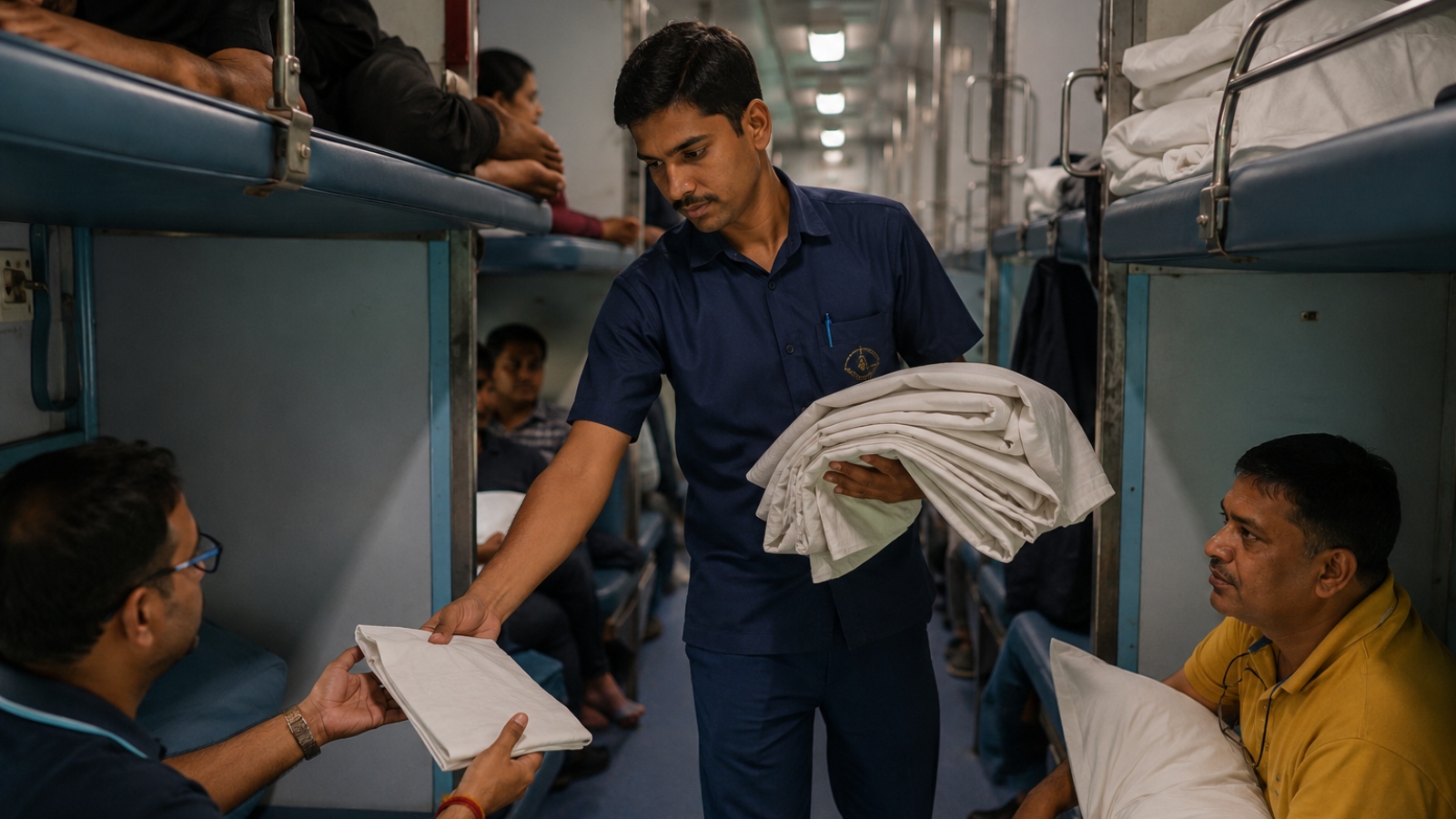
In the video, Amit Yadav, who says he earns Rs 14,000 a month, explains that his job involves distributing linen kits to passengers in AC coaches and collecting every bedsheet, blanket and towel before the train reaches its destination.
According to Yadav, not every item is returned, and attendants are often made to bear the financial burden. He says the amount recovered depends on what goes missing. A missing towel costs him Rs 60, a bedsheet Rs 250, and a blanket Rs 700. For someone earning Rs 14,000 a month, even a few missing items can significantly slash their salary.
Yadav recalled an incident that left a lasting impact on him. He said he once had to pay Rs 5,000 from his own pocket after several linen items disappeared during a single trip. Since then, he has become more cautious, but preventing theft has remained difficult.
To reduce the number of stolen towels, attendants have changed the way they distribute them. Instead of including a towel in every bedroll, they now usually hand one over only when a passenger specifically asks for it.
Even that, Yadav says, has not completely solved the problem. He recalled a recent journey involving a passenger travelling to Delhi who questioned why there was no towel in the linen kit. After Yadav explained that towels are now given only on request because many passengers steal them, the traveller allegedly took the towel home anyway.
The video ends with Singh making a simple appeal: “Please stop stealing.”
The video has resonated with many social media users, who expressed sympathy for the railway attendant while criticising those who take railway property home.
One user wrote, “I don’t understand why ppl take stuff from train hotels etc … Like it’s their property why we would take it .. i don’t understand ppls mentality yaar.”
Another commented, “Workers ki kya galti (What fault is it of the workers)? The whole system is not strict enough, install cameras and you have the info if anyone steals anything they need to find that person and charge fines just like breaking traffic rules, Idc how hard it is its their job to make it possible… civic sense hi nahi hai (People have no civic sense), to jaise ko taise krke fine lagao tabhi sudhrenge (Fine them in the same way, only then will they improve)… salary pe kam karne vale logo ko kyu pareshan krna (Why trouble people who work on salaries)?”
A third person added, “They will put up stories and reels of civic sense, but when their time comes, these will be at the lowest.”
For many railway passengers travelling in AC coaches in India, the bedsheets, blankets and towels provided during the journey are simply part of the service. While most travellers return the linen before getting off the train, some choose to take it home, often without considering who has to account for the missing items.
A viral Instagram video has now brought attention to the issue after an Indian Railways attendant claimed that the cost of stolen linen is deducted from his salary.
The video was shared by YouTuber Naveen Singh, who urged people to think about the workers affected by such incidents. Posting the clip, he wrote, “Thoda in logo ka bhi soche (Think about them too).”
In the video, Amit Yadav, who says he earns Rs 14,000 a month, explains that his job involves distributing linen kits to passengers in AC coaches and collecting every bedsheet, blanket and towel before the train reaches its destination.
According to Yadav, not every item is returned, and attendants are often made to bear the financial burden. He says the amount recovered depends on what goes missing. A missing towel costs him Rs 60, a bedsheet Rs 250, and a blanket Rs 700. For someone earning Rs 14,000 a month, even a few missing items can significantly slash their salary.
Yadav recalled an incident that left a lasting impact on him. He said he once had to pay Rs 5,000 from his own pocket after several linen items disappeared during a single trip. Since then, he has become more cautious, but preventing theft has remained difficult.
To reduce the number of stolen towels, attendants have changed the way they distribute them. Instead of including a towel in every bedroll, they now usually hand one over only when a passenger specifically asks for it.
Even that, Yadav says, has not completely solved the problem. He recalled a recent journey involving a passenger travelling to Delhi who questioned why there was no towel in the linen kit. After Yadav explained that towels are now given only on request because many passengers steal them, the traveller allegedly took the towel home anyway.
The video ends with Singh making a simple appeal: “Please stop stealing.”
The video has resonated with many social media users, who expressed sympathy for the railway attendant while criticising those who take railway property home.
One user wrote, “I don’t understand why ppl take stuff from train hotels etc … Like it’s their property why we would take it .. i don’t understand ppls mentality yaar.”
Another commented, “Workers ki kya galti (What fault is it of the workers)? The whole system is not strict enough, install cameras and you have the info if anyone steals anything they need to find that person and charge fines just like breaking traffic rules, Idc how hard it is its their job to make it possible… civic sense hi nahi hai (People have no civic sense), to jaise ko taise krke fine lagao tabhi sudhrenge (Fine them in the same way, only then will they improve)… salary pe kam karne vale logo ko kyu pareshan krna (Why trouble people who work on salaries)?”
A third person added, “They will put up stories and reels of civic sense, but when their time comes, these will be at the lowest.”