

Pi Day 2026: Google marks March 14 with interactive doodle celebrating the mathematical constant
Pi refers to the ratio of a circle’s circumference to its diameter. The concept was popularised in 1988 when physicist Larry Shaw organised the first Pi Day event at the San Francisco Exploratorium.
Pi Day is observed every year on March 14 to celebrate the mathematical constant π (pi), a number that plays a crucial role in mathematics and science. The date – written as 3/14 – reflects the first three digits of pi (3.14), which is why the day has become a favourite among mathematicians, students, and science lovers. Joining the celebrations this year, Google unveiled a vibrant and interactive doodle that was visible globally, highlighting the importance of this fundamental mathematical concept.
Pi refers to the ratio of a circle’s circumference to its diameter. The concept was popularised in 1988 when physicist Larry Shaw organised the first Pi Day event at the San Francisco Exploratorium. Pi is classified as an irrational number, meaning its decimal form goes on forever without repeating. Because of this unique property, it appears in countless mathematical and physical formulas.
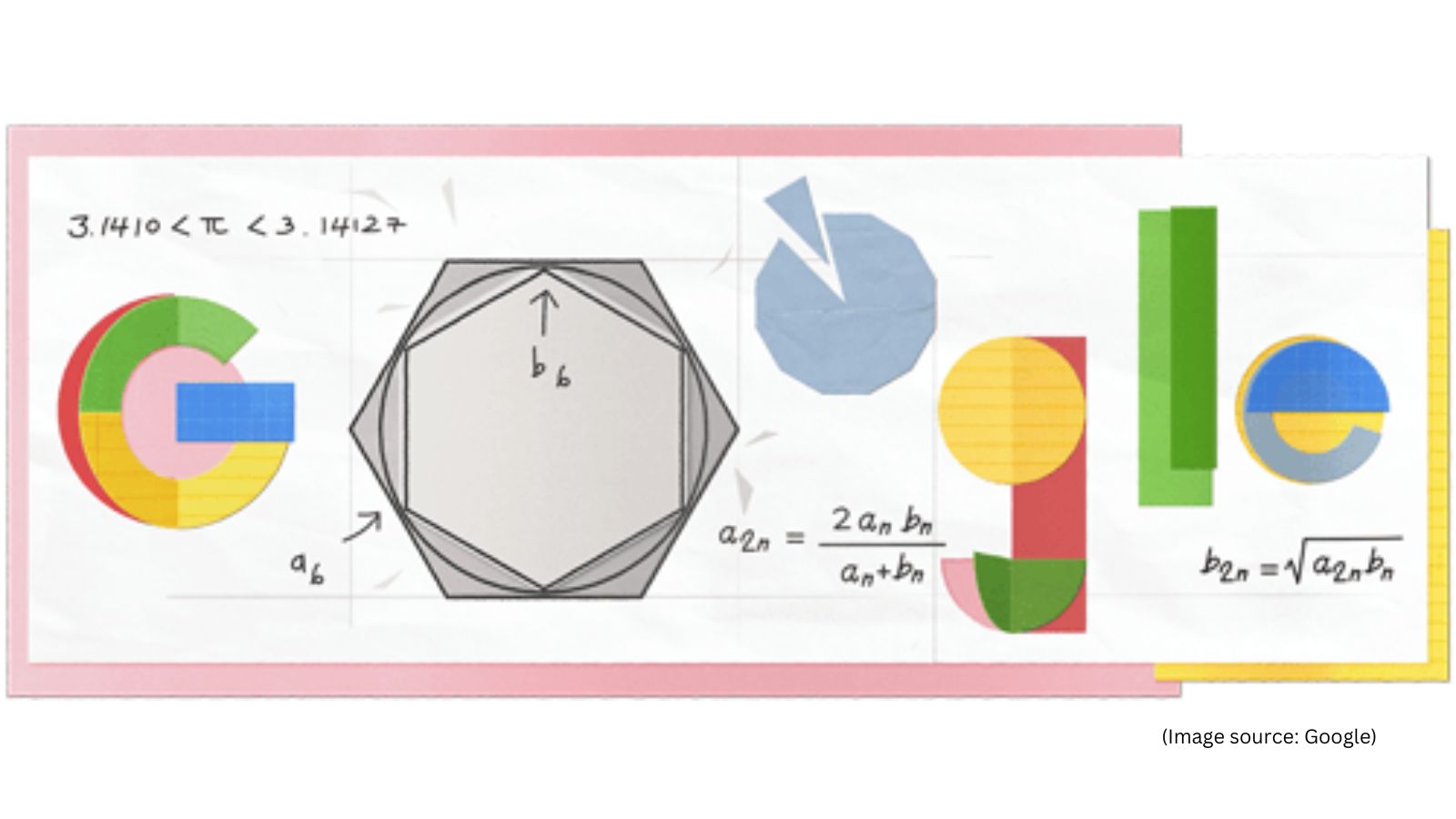
Google’s doodle description notes, “This Doodle celebrates the numerical constant pi (π), highlighting the foundational geometry first used to calculate its limits. Long before modern technology, the Greek mathematician Archimedes popularized an innovative approach.”
Over the centuries, many mathematicians attempted to calculate the value of pi using different techniques. Notable contributors include Archimedes, Fibonacci, François Viète, Adriaan van Roomen, and Gottfried Wilhelm Leibniz. However, it was Welsh mathematician William Jones who first used the Greek symbol π in 1706 to represent this ratio.
As early as around 250 BC, Archimedes developed a clever method to estimate Pi’s value by placing a circle between two 96-sided polygons. This helped him determine both the upper and lower limits of the constant with impressive accuracy for his time.
The modern celebration of Pi Day began in 1988 – a tradition that continues even today. The occasion gained wider recognition in the United States in 2009, when the House of Representatives passed a non-binding resolution declaring March 14 as National Pi Day.
India also has its own remarkable connection to Pi. Rajveer Meena from Rajasthan set a Guinness World Record by memorising 70,000 decimal places of Pi. He accomplished this feat at VIT University in Vellore on March 21, 2015, reciting the digits blindfolded over nearly 10 hours.
Pi Day is observed every year on March 14 to celebrate the mathematical constant π (pi), a number that plays a crucial role in mathematics and science. The date – written as 3/14 – reflects the first three digits of pi (3.14), which is why the day has become a favourite among mathematicians, students, and science lovers. Joining the celebrations this year, Google unveiled a vibrant and interactive doodle that was visible globally, highlighting the importance of this fundamental mathematical concept.
Pi refers to the ratio of a circle’s circumference to its diameter. The concept was popularised in 1988 when physicist Larry Shaw organised the first Pi Day event at the San Francisco Exploratorium. Pi is classified as an irrational number, meaning its decimal form goes on forever without repeating. Because of this unique property, it appears in countless mathematical and physical formulas.
Google’s doodle description notes, “This Doodle celebrates the numerical constant pi (π), highlighting the foundational geometry first used to calculate its limits. Long before modern technology, the Greek mathematician Archimedes popularized an innovative approach.”
Over the centuries, many mathematicians attempted to calculate the value of pi using different techniques. Notable contributors include Archimedes, Fibonacci, François Viète, Adriaan van Roomen, and Gottfried Wilhelm Leibniz. However, it was Welsh mathematician William Jones who first used the Greek symbol π in 1706 to represent this ratio.
As early as around 250 BC, Archimedes developed a clever method to estimate Pi’s value by placing a circle between two 96-sided polygons. This helped him determine both the upper and lower limits of the constant with impressive accuracy for his time.
The modern celebration of Pi Day began in 1988 – a tradition that continues even today. The occasion gained wider recognition in the United States in 2009, when the House of Representatives passed a non-binding resolution declaring March 14 as National Pi Day.
India also has its own remarkable connection to Pi. Rajveer Meena from Rajasthan set a Guinness World Record by memorising 70,000 decimal places of Pi. He accomplished this feat at VIT University in Vellore on March 21, 2015, reciting the digits blindfolded over nearly 10 hours.