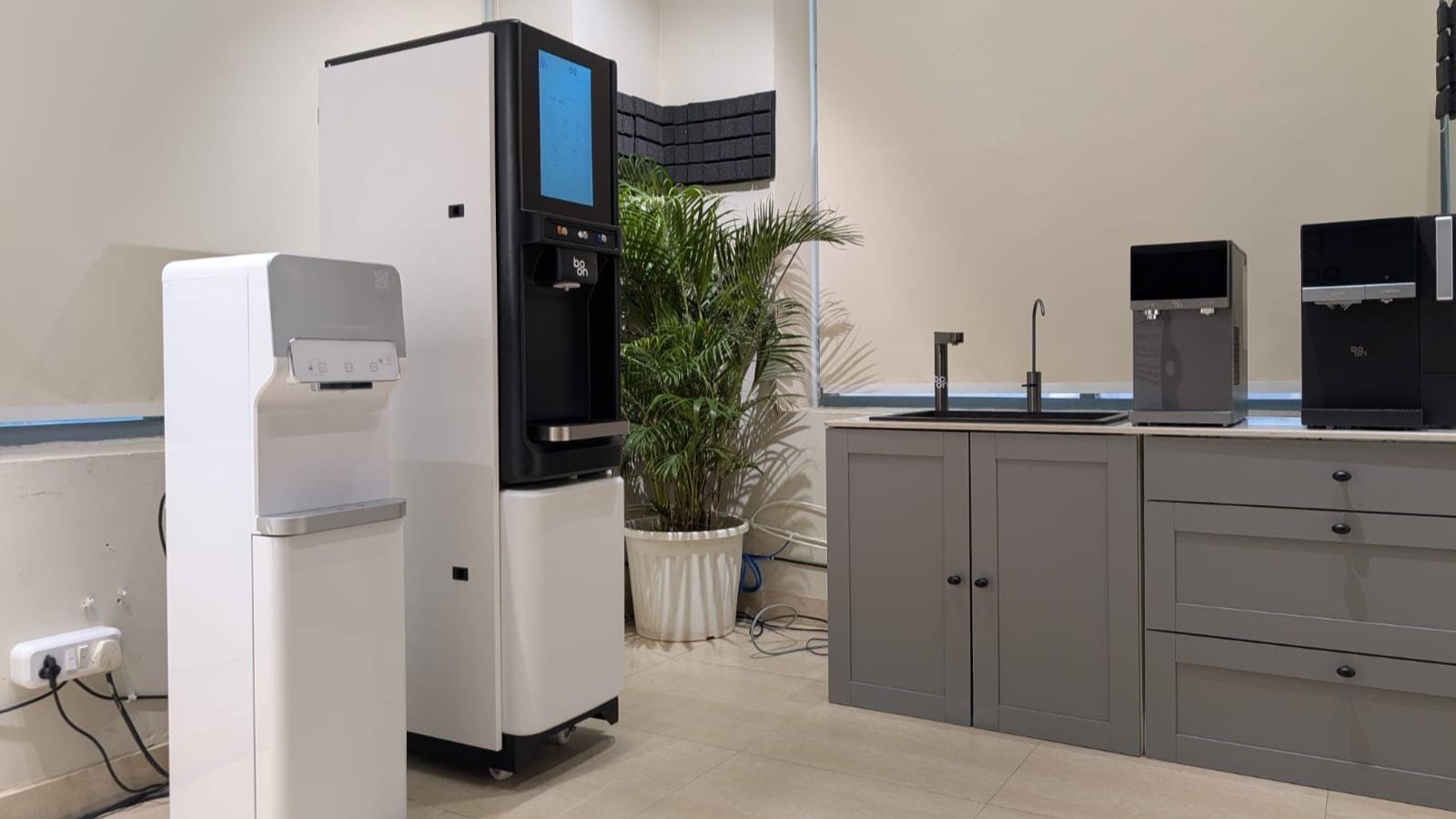


How Gurgaon-based Boon is turning water purifiers into premium smart wellness devices
Advait Kumar, co-founder and CEO of Boon, believes in technology that “lives in the background, not at the forefront”, a philosophy that forms the foundation of how he and his team are engineering a new kind of “water tech” platform.
“Technology is something you are always interacting with. It’s with you and part of your daily life. But there’s another side of technology that runs in the background, making your life better and ensuring that everything around you works properly,” says Advait Kumar, explaining the difference between a tech product that is front and center in your life and one that seamlessly fades into the background.
Kumar, who is a co-founder and CEO of Gurgaon-based Boon, believes in technology that “lives in the background, not at the forefront”, a philosophy that forms the foundation of how he and his team are engineering a new kind of “water tech” platform.
With a bachelor’s degree in electrical engineering and economics from Penn State University and experience working at JPMorgan in the US, Kumar returned to India to start Boon in 2014. Back then, the company was called Swajal, a social impact venture whose water vending kiosks, dubbed WaterATMs, caught the attention of various state governments and the public at large. The idea was inspired by Dr Vibha Tripathi, a physics graduate and PhD holder from the Indian Institute of Technology Kanpur and Kumar’s mother. While working on a UNDP-funded project, she realised the importance of providing clean drinking water to underserved communities and began researching solutions for water purification.
However, in 2019, Kumar transitioned the company from rural WaterATMs to a tech-driven wellness platform, which is what Boon is known as today. Despite the shift, clean water remains at the core of the startup’s approach and mission.
“We decided to move into the wellness segment because we believed that water is the underpinning and foundation of everything we do. If that foundation is strong, then whether you are making a smoothie, preparing a drink, or simply hydrating yourself properly every day, it makes a real difference,” Kumar told indianexpress.com in an interview.
For Kumar, Boon is a technology company working on wellness through water. “We have been working on the technology side for a very long time, and it has finally reached a point where we decided to apply that technology to wellness. That is because things like water and even air are essential for humans, yet it’s not always easy to distinguish the quality or understand the process behind them unless something is seriously wrong. There’s a lot of opacity in the space,” he explains.
For the past few years, the startup has made its presence felt on the B2B side of the business, with clients across the hospitality sector and large corporates. Boon offers commercial-grade products, including micro water bottling plants and high-end purification systems for hotels and offices. However, the company has recently pivoted toward home water purification solutions.
Boon currently offers two products, one of which is the Boon Tall, a high-capacity water purification system that provides hot, normal, and cold water options in a compact design for homes as well as businesses requiring up to 60 liters per hour. The product is priced at Rs 49,990.
The second product, Boon Tap, is a uniquely designed water purifier. Its Sleek, made of steel, and has the shape of a tap, hence the name Boon Tap. The purifier itself is installed behind the system, while users access purified water directly through the tap above. The Boon Tap retails for Rs 20,500.
“Instead of having a knob, it features a toggle. We didn’t want people to feel like they were using a traditional appliance. In modern homes, user interfaces are more intuitive – you use a toggle to switch something on or off rather than turning a knob. There are small design elements like that throughout the product. Even the machine beneath is very compact and designed with a sleek glass finish,” Kumar said.
To design the Boon Tap, Advait Kumar and his team drew inspiration from Bang & Olufsen, a company known for its premium audio products that has distinct aesthetics and luxurious design, placing them in a league of their own. Kumar is positioning the Boon Tap as a lifestyle product rather than just a conventional water purifier one traditionally seen across Indian homes.
“It is basically an under-sink water purifier with two separate units. One is the dispensing unit, from which you get the water, and the other is the purification unit. The purification unit can be installed anywhere…under the sink, beneath the counter, or even farther away,” he explains.
The Boon Tap is designed with two separate units, similar to a split AC system: one unit can be installed discreetly wherever the user wants to hide it, while the visible unit is simply the tap through which the water is dispensed. “It works with a simple on-and-off mechanism, and we also have an app that allows users to set different modes, such as selecting the kind of water they want,” Kumar said.
Not only is the design team in-house, but the company also handles embedded IoT components and PCB assembly internally, bringing end-to-end production under one roof. Kumar said the consumer products are manufactured at the company’s factory in Gurgaon, Haryana, while commercial products are produced at its factory in Ahmedabad, Gujarat.
Kumar said the company’s filtration system is “over-engineered” at every stage, with filters lasting about 30 months (roughly two and a half years) and a replacement cost of approximately Rs 5,000 for the full set. However, the company also allows users to purchase individual filters separately.
“Our polypropylene (PP) filter has grooves in it, which allow it to hold more dirt. In fact, our PP filters can hold up to two times more dirt than regular PP filters, while our membrane can operate at up to 2,500 total dissolved solids level (TDS), whereas most membranes start giving up at 1500 TDS,” explained Kumar.
The system also includes a full UV sterilization stage, meaning every drop of water is treated effectively. It’s designed to be an open platform, allowing users to replace filters themselves and even use third-party filters. “If you want to use any filter, you can. If you want to replace the filters yourself, you can simply buy them and do it on your own,” Kumar said. “We have also made the process very easy for users, and internally, we call it an open platform, though we haven’t actively promoted it that way yet,” he added.
Kumar said the company’s products are inspired by connected smart home devices, especially how Google’s Nest thermostat works, where the technology stays in the background and learns user patterns, rather than being intrusive or constantly in the user’s face. In the case of its Boon products, the tech behind them not only monitors the quality of water but also measures the temperature. If the temperature is very high, for example, the app gives you an alert.
“If you have a water tank on your roof and very hot water is coming through it, the heat can damage your RO membrane, which is essentially a synthetic polymer. When exposed to high temperatures, it expands and allows more particles to pass through its pores,” he explained, while describing the difference between water purifiers with RO technology and Boon.
Kumar describes the Boon Tap, for example, a tech product, similar to a smartphone, highlighting its Ultra Osmosis technology, which combines multiple filtration stages to deliver longer filter life, reduced water wastage, and improved water quality.
Since 2019, Kumar said the company has been working on artificial intelligence technology used for predictive maintenance, originally developed for commercial clients such as JW Marriott. The company’s AI monitors parameters such as water temperature, TDS levels, and usage trends to forecast filter life and prevent sudden failures. Instead of using multimodal models, Kumar said the company uses Amazon’s time-series model Chronos.
According to Kumar, the idea is to use artificial intelligence to manage filters effectively. Kumar says the AI technology, which was previously limited to its commercial products, is also being integrated into consumer products.
Meanwhile, the companion app that works with both Boon Tap and Tall serves as a status display for AI predictions, using simple emoticons to communicate filter health and replacement likelihood. The interface, according to Kumar, avoids technical jargon or complex statistics, instead showing happy or sad faces along with straightforward replacement timelines.
Kumar’s vision is to change the perception that water purifiers can be as personal and aesthetically designed as premium, upmarket consumer electronics, such as a high-end iPhone, a premium OLED TV, or a connected refrigerator. “Water purifiers have become such a fixture in homes that I think design, beauty, aesthetics, and quality will matter a lot more than just having one,” explains Kumar.
No wonder Kumar is aiming to market its water purifiers as a “wellness” product, particularly the Boon Tap, which he believes will resonate more with consumers who value kitchen design and view its products as premium, connected appliances.
Boon competes directly with established water purifier brands such as Kent, but Kumar’s company differentiates itself through its design, technology, and focus on mineralised, healthy water.
Kumar plans to sell Boon Tap through multiple channels, including Amazon, but with a stronger emphasis on partnerships with fitness events, opening pop-up stores, and high-end malls in cities such as Gurgaon, Hyderabad, Bengaluru, Chennai, and Mumbai. Kumar adds that large-format retail is less of a priority, with a focus on curated, experiential sales touchpoints that align with the brand’s premium positioning. The plan also includes leveraging commercial architects and interior designers to integrate the products into high-end kitchens and commercial spaces.
The startup has 400 employees in total, with 300 of them being technicians. Kumar said the company’s commercial operations have a sizable footprint in countries such as the Maldives, Bangladesh, Nepal, and Bhutan, and it is already taking on large-scale projects outside India. For its consumer products, however, India remains the primary focus for now, and the company is working on a differentiated go-to-market strategy.
As of now, the commercial side generates profits and serves as the company’s core strength, while the home segment is expected to drive the bulk of future revenue growth, says Kumar.
Boon has investors, including the Department of Science and Technology and the Spanish sanitary ware company Roca, among others. Kumar said there is no pressure to raise additional capital at the moment.
Kumar’s Boon is working on multiple new products and testing new markets. For example, there is a water purifier that can be placed on a desk and can also dispense sparkling water, as well as a similar product that also produces ice. These products are currently premium-priced and targeted at luxury hotels and offices.
For Kumar, the challenge is scaling these advanced products to price points that are affordable for broader consumer markets without compromising quality.
“Technology is something you are always interacting with. It’s with you and part of your daily life. But there’s another side of technology that runs in the background, making your life better and ensuring that everything around you works properly,” says Advait Kumar, explaining the difference between a tech product that is front and center in your life and one that seamlessly fades into the background.
Kumar, who is a co-founder and CEO of Gurgaon-based Boon, believes in technology that “lives in the background, not at the forefront”, a philosophy that forms the foundation of how he and his team are engineering a new kind of “water tech” platform.
With a bachelor’s degree in electrical engineering and economics from Penn State University and experience working at JPMorgan in the US, Kumar returned to India to start Boon in 2014. Back then, the company was called Swajal, a social impact venture whose water vending kiosks, dubbed WaterATMs, caught the attention of various state governments and the public at large. The idea was inspired by Dr Vibha Tripathi, a physics graduate and PhD holder from the Indian Institute of Technology Kanpur and Kumar’s mother. While working on a UNDP-funded project, she realised the importance of providing clean drinking water to underserved communities and began researching solutions for water purification.
However, in 2019, Kumar transitioned the company from rural WaterATMs to a tech-driven wellness platform, which is what Boon is known as today. Despite the shift, clean water remains at the core of the startup’s approach and mission.
“We decided to move into the wellness segment because we believed that water is the underpinning and foundation of everything we do. If that foundation is strong, then whether you are making a smoothie, preparing a drink, or simply hydrating yourself properly every day, it makes a real difference,” Kumar told indianexpress.com in an interview.
For Kumar, Boon is a technology company working on wellness through water. “We have been working on the technology side for a very long time, and it has finally reached a point where we decided to apply that technology to wellness. That is because things like water and even air are essential for humans, yet it’s not always easy to distinguish the quality or understand the process behind them unless something is seriously wrong. There’s a lot of opacity in the space,” he explains.
For the past few years, the startup has made its presence felt on the B2B side of the business, with clients across the hospitality sector and large corporates. Boon offers commercial-grade products, including micro water bottling plants and high-end purification systems for hotels and offices. However, the company has recently pivoted toward home water purification solutions.
Boon currently offers two products, one of which is the Boon Tall, a high-capacity water purification system that provides hot, normal, and cold water options in a compact design for homes as well as businesses requiring up to 60 liters per hour. The product is priced at Rs 49,990.
The second product, Boon Tap, is a uniquely designed water purifier. Its Sleek, made of steel, and has the shape of a tap, hence the name Boon Tap. The purifier itself is installed behind the system, while users access purified water directly through the tap above. The Boon Tap retails for Rs 20,500.
“Instead of having a knob, it features a toggle. We didn’t want people to feel like they were using a traditional appliance. In modern homes, user interfaces are more intuitive – you use a toggle to switch something on or off rather than turning a knob. There are small design elements like that throughout the product. Even the machine beneath is very compact and designed with a sleek glass finish,” Kumar said.
To design the Boon Tap, Advait Kumar and his team drew inspiration from Bang & Olufsen, a company known for its premium audio products that has distinct aesthetics and luxurious design, placing them in a league of their own. Kumar is positioning the Boon Tap as a lifestyle product rather than just a conventional water purifier one traditionally seen across Indian homes.
“It is basically an under-sink water purifier with two separate units. One is the dispensing unit, from which you get the water, and the other is the purification unit. The purification unit can be installed anywhere…under the sink, beneath the counter, or even farther away,” he explains.
The Boon Tap is designed with two separate units, similar to a split AC system: one unit can be installed discreetly wherever the user wants to hide it, while the visible unit is simply the tap through which the water is dispensed. “It works with a simple on-and-off mechanism, and we also have an app that allows users to set different modes, such as selecting the kind of water they want,” Kumar said.
Not only is the design team in-house, but the company also handles embedded IoT components and PCB assembly internally, bringing end-to-end production under one roof. Kumar said the consumer products are manufactured at the company’s factory in Gurgaon, Haryana, while commercial products are produced at its factory in Ahmedabad, Gujarat.
Kumar said the company’s filtration system is “over-engineered” at every stage, with filters lasting about 30 months (roughly two and a half years) and a replacement cost of approximately Rs 5,000 for the full set. However, the company also allows users to purchase individual filters separately.
“Our polypropylene (PP) filter has grooves in it, which allow it to hold more dirt. In fact, our PP filters can hold up to two times more dirt than regular PP filters, while our membrane can operate at up to 2,500 total dissolved solids level (TDS), whereas most membranes start giving up at 1500 TDS,” explained Kumar.
The system also includes a full UV sterilization stage, meaning every drop of water is treated effectively. It’s designed to be an open platform, allowing users to replace filters themselves and even use third-party filters. “If you want to use any filter, you can. If you want to replace the filters yourself, you can simply buy them and do it on your own,” Kumar said. “We have also made the process very easy for users, and internally, we call it an open platform, though we haven’t actively promoted it that way yet,” he added.
Kumar said the company’s products are inspired by connected smart home devices, especially how Google’s Nest thermostat works, where the technology stays in the background and learns user patterns, rather than being intrusive or constantly in the user’s face. In the case of its Boon products, the tech behind them not only monitors the quality of water but also measures the temperature. If the temperature is very high, for example, the app gives you an alert.
“If you have a water tank on your roof and very hot water is coming through it, the heat can damage your RO membrane, which is essentially a synthetic polymer. When exposed to high temperatures, it expands and allows more particles to pass through its pores,” he explained, while describing the difference between water purifiers with RO technology and Boon.
Kumar describes the Boon Tap, for example, a tech product, similar to a smartphone, highlighting its Ultra Osmosis technology, which combines multiple filtration stages to deliver longer filter life, reduced water wastage, and improved water quality.
Since 2019, Kumar said the company has been working on artificial intelligence technology used for predictive maintenance, originally developed for commercial clients such as JW Marriott. The company’s AI monitors parameters such as water temperature, TDS levels, and usage trends to forecast filter life and prevent sudden failures. Instead of using multimodal models, Kumar said the company uses Amazon’s time-series model Chronos.
According to Kumar, the idea is to use artificial intelligence to manage filters effectively. Kumar says the AI technology, which was previously limited to its commercial products, is also being integrated into consumer products.
Meanwhile, the companion app that works with both Boon Tap and Tall serves as a status display for AI predictions, using simple emoticons to communicate filter health and replacement likelihood. The interface, according to Kumar, avoids technical jargon or complex statistics, instead showing happy or sad faces along with straightforward replacement timelines.
Kumar’s vision is to change the perception that water purifiers can be as personal and aesthetically designed as premium, upmarket consumer electronics, such as a high-end iPhone, a premium OLED TV, or a connected refrigerator. “Water purifiers have become such a fixture in homes that I think design, beauty, aesthetics, and quality will matter a lot more than just having one,” explains Kumar.
No wonder Kumar is aiming to market its water purifiers as a “wellness” product, particularly the Boon Tap, which he believes will resonate more with consumers who value kitchen design and view its products as premium, connected appliances.
Boon competes directly with established water purifier brands such as Kent, but Kumar’s company differentiates itself through its design, technology, and focus on mineralised, healthy water.
Kumar plans to sell Boon Tap through multiple channels, including Amazon, but with a stronger emphasis on partnerships with fitness events, opening pop-up stores, and high-end malls in cities such as Gurgaon, Hyderabad, Bengaluru, Chennai, and Mumbai. Kumar adds that large-format retail is less of a priority, with a focus on curated, experiential sales touchpoints that align with the brand’s premium positioning. The plan also includes leveraging commercial architects and interior designers to integrate the products into high-end kitchens and commercial spaces.
The startup has 400 employees in total, with 300 of them being technicians. Kumar said the company’s commercial operations have a sizable footprint in countries such as the Maldives, Bangladesh, Nepal, and Bhutan, and it is already taking on large-scale projects outside India. For its consumer products, however, India remains the primary focus for now, and the company is working on a differentiated go-to-market strategy.
As of now, the commercial side generates profits and serves as the company’s core strength, while the home segment is expected to drive the bulk of future revenue growth, says Kumar.
Boon has investors, including the Department of Science and Technology and the Spanish sanitary ware company Roca, among others. Kumar said there is no pressure to raise additional capital at the moment.
Kumar’s Boon is working on multiple new products and testing new markets. For example, there is a water purifier that can be placed on a desk and can also dispense sparkling water, as well as a similar product that also produces ice. These products are currently premium-priced and targeted at luxury hotels and offices.
For Kumar, the challenge is scaling these advanced products to price points that are affordable for broader consumer markets without compromising quality.