



‘India is building AI, not just using it’: Sam Altman at Express Adda, key takeaways
AI is advancing faster than societies can adapt, and India sits at the centre of that transition. At Express Adda, Sam Altman spoke on talent, infrastructure, jobs and the approaching era of AGI.
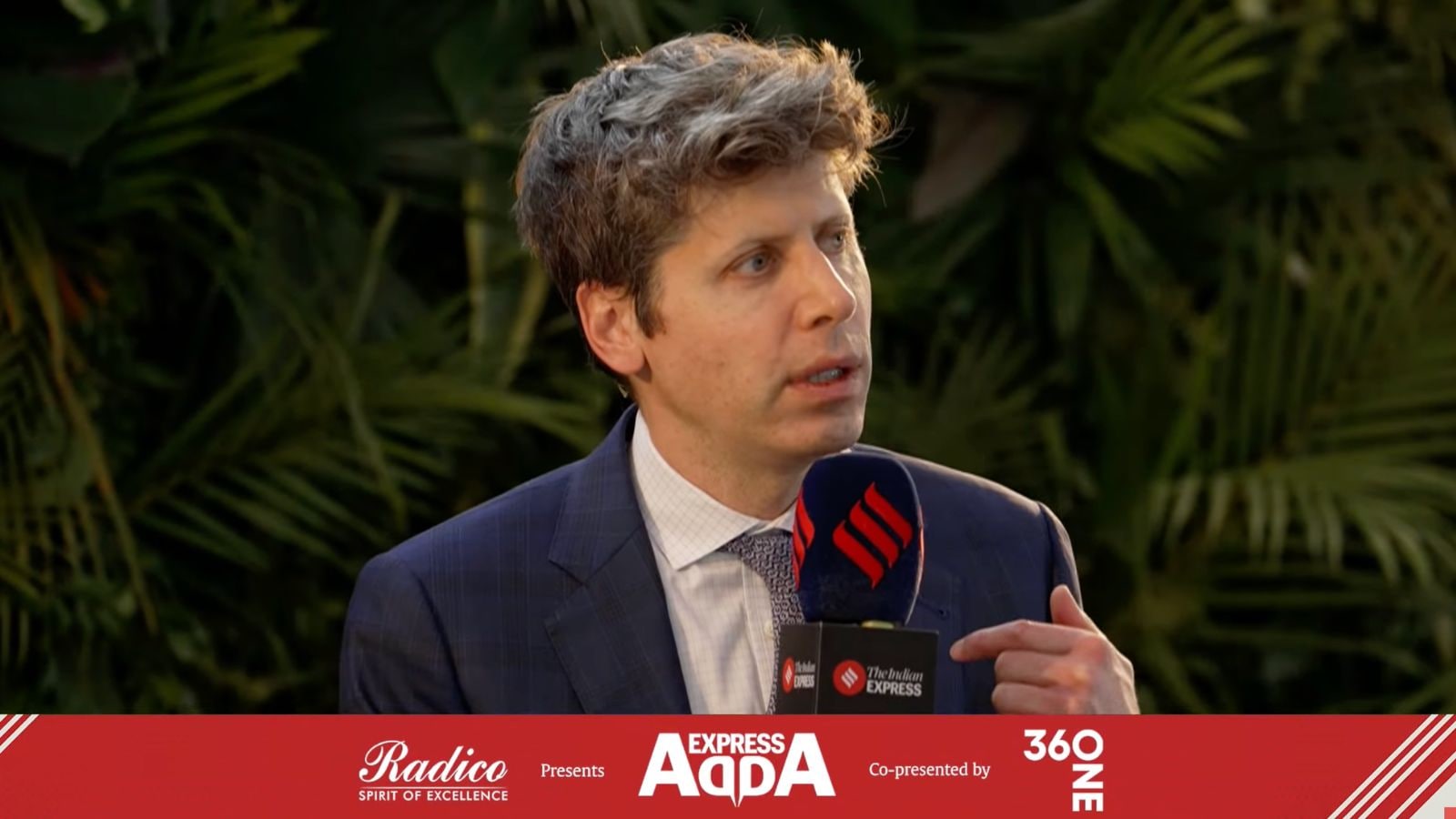
OpenAI CEO Sam Altman, on Friday, February 20, painted a vivid picture of artificial intelligence (AI) and its implications for India and the world. The CEO sat down with Anant Goenka, Executive Director of The Indian Express Group, at Express Adda in New Delhi. In the hour-long interaction, the OpenAI executive touched upon a wide range of topics surrounding AI, from intensifying competition to talent wars to massive infrastructure investments to gargantuan levels of compute deemed necessary for frontier models.
Altman also expressed his views on India. He sees the fourth-largest economy as a rapidly emerging AI powerhouse with remarkable builder energy and the fastest-growing Codex market globally. He believes India should develop the complete AI stack vertically and democratise AI technology. Even though optimistic about India’s potential to lead, he acknowledged job displacement challenges that require rapid adaptation.
His remarks evoke a kind of leadership that is acutely aware of AI’s transformative power while at the same time staying practical and cognisant of the challenge it poses. Below are the key takeaways from the session:
The OpenAI CEO kicked off by positioning recent advancements in context. He shared that a year ago, AI systems were merely solving high school math problems, but today OpenAI’s latest models can crack a majority of unsolved, research-level mathematical problems. This is not just incremental progress, as it demonstrates a fundamental shift in AI’s capabilities. However, Altman was quick to snub personal credit, acknowledging that the scientific discovery belonged to researchers who developed the deep learning algorithms that improve at scale. His view here highlights an important aspect of the ongoing AI revolution, which is fundamentally a story of algorithmic breakthroughs and not just about a handful of visionaries.
During his interaction, Altman noted a striking change since his last visit to India. Today, India has become OpenAI’s fastest-growing market for its programming tool named Codex. Most importantly, India has moved over from being a consumer of AI technology to a hub teeming with builder energy. However, when pushed for his controversial stance on India’s capacity to build a frontier language model with limited funding, Altman clarified his position. A $10 million budget cannot create a cutting-edge ‘frontier’ model, a statement that rings more true today with development costs skyrocketing. However, the CEO stressed that with sufficient capital, Indian companies are absolutely capable of building advanced models.
Ever since the dawn of ChatGPT, there has been no topic that has triggered more collective anxiety worldwide than AI’s impact on employment. In his measured responses, the OpenAI CEO, although did not minimise the woes, especially for India’s IT sector, which is roughly 8 per cent of the country’s GDP. He acknowledged that the disruption will be significant and pretending otherwise will not be beneficial.
Even though each technological revolution has sparked fears of mass unemployment, societies have evolved and adapted to the change gradually. Altman also made the case for new opportunities that emerge alongside technological advancements. The skills that would remain valuable amid the AI revolution would be mostly fluency with AI tools, resilience, adaptability, and most importantly one’s ability to understand how to be useful to others.
Another key theme that emerged from the conversation was around the physical infrastructure that is needed to bolster the growth of AI. Altman stressed that the world is currently short of sufficient computing power for India to become a fully AI-first society. To build this capacity would mean unprecedented global cooperation and would require the most expensive, complex infrastructure project ever undertaken. When asked about space-based data centres, Altman quipped that it was a ridiculous idea. “We are not there yet. There will come a time when space will be great for a lot of things, but orbital data centres won’t happen in the next decade.”
This need for massive infrastructure buildout also requires close relationships between technology companies and governments, as it is also important to ensure that AI development remains safe and equitable.
Based on Altman’s responses, the global AI landscape is competitive as well as interdependent at the same time. While China is leading in humanoid robot manufacturing and energy infrastructure, other nations excel elsewhere. Instead of seeing this as a winner-take-all race, the OpenAI CEO bats for democratic societies taking the lead in AI development. He firmly believes that it is critical that no single country, organisation, or individual controls superintelligence. This also offers a glimpse of his view on power concentration.
When asked about some common criticism, Altman offered some substantive answers. On power concentration, he conceded it’s a fair criticism ‘unless we push super hard to democratise.’ The water usage criticism he dismissed as ‘totally fake’ given modern cooling techniques, but he acknowledged the energy consumption problem is genuine and requires rapid movement toward nuclear, wind, and solar power.
When asked whether AI makes children dumber, Altman offered some nuance. While some students use AI to cheat, most report amazement at their newfound capabilities. According to him, education systems will need to evolve; however, he expressed confidence that children today will graduate high school capable of extraordinary accomplishments. “We’ll have to find new ways to teach and evaluate, but I’m pretty sure a kid born today will be able to do things when they graduate high school that no one today can do.”
When touched upon the speculations around Artificial General Intelligence (AGI) and Artificial Superintelligence (ASI), Altman gave a sobering yet measured view. He feels AGI is close, and superintelligence isn’t far beyond. This accelerating timeline intensifies the significance of responsible development and international cooperation. During the interaction, when asked about his greatest regrets, Altman cited keeping OpenAI as a nonprofit.
Perhaps the most compelling part was Altman’s reflection on AI’s ultimate impact on human relationships. “My bet is that we will value human relationships much more. Human connection and human warmth will become one of the most valuable commodities.”
This view that technological progress should enhance rather than diminish human flourishing ultimately captures Altman’s vision for AI’s future. The technology here is merely a tool, and humanity’s choices about its deployment will determine whether AI becomes a force for democratisation or concentration, connection, or isolation.
OpenAI CEO Sam Altman, on Friday, February 20, painted a vivid picture of artificial intelligence (AI) and its implications for India and the world. The CEO sat down with Anant Goenka, Executive Director of The Indian Express Group, at Express Adda in New Delhi. In the hour-long interaction, the OpenAI executive touched upon a wide range of topics surrounding AI, from intensifying competition to talent wars to massive infrastructure investments to gargantuan levels of compute deemed necessary for frontier models.
Altman also expressed his views on India. He sees the fourth-largest economy as a rapidly emerging AI powerhouse with remarkable builder energy and the fastest-growing Codex market globally. He believes India should develop the complete AI stack vertically and democratise AI technology. Even though optimistic about India’s potential to lead, he acknowledged job displacement challenges that require rapid adaptation.
His remarks evoke a kind of leadership that is acutely aware of AI’s transformative power while at the same time staying practical and cognisant of the challenge it poses. Below are the key takeaways from the session:
The OpenAI CEO kicked off by positioning recent advancements in context. He shared that a year ago, AI systems were merely solving high school math problems, but today OpenAI’s latest models can crack a majority of unsolved, research-level mathematical problems. This is not just incremental progress, as it demonstrates a fundamental shift in AI’s capabilities. However, Altman was quick to snub personal credit, acknowledging that the scientific discovery belonged to researchers who developed the deep learning algorithms that improve at scale. His view here highlights an important aspect of the ongoing AI revolution, which is fundamentally a story of algorithmic breakthroughs and not just about a handful of visionaries.
During his interaction, Altman noted a striking change since his last visit to India. Today, India has become OpenAI’s fastest-growing market for its programming tool named Codex. Most importantly, India has moved over from being a consumer of AI technology to a hub teeming with builder energy. However, when pushed for his controversial stance on India’s capacity to build a frontier language model with limited funding, Altman clarified his position. A $10 million budget cannot create a cutting-edge ‘frontier’ model, a statement that rings more true today with development costs skyrocketing. However, the CEO stressed that with sufficient capital, Indian companies are absolutely capable of building advanced models.
Ever since the dawn of ChatGPT, there has been no topic that has triggered more collective anxiety worldwide than AI’s impact on employment. In his measured responses, the OpenAI CEO, although did not minimise the woes, especially for India’s IT sector, which is roughly 8 per cent of the country’s GDP. He acknowledged that the disruption will be significant and pretending otherwise will not be beneficial.
Even though each technological revolution has sparked fears of mass unemployment, societies have evolved and adapted to the change gradually. Altman also made the case for new opportunities that emerge alongside technological advancements. The skills that would remain valuable amid the AI revolution would be mostly fluency with AI tools, resilience, adaptability, and most importantly one’s ability to understand how to be useful to others.
Another key theme that emerged from the conversation was around the physical infrastructure that is needed to bolster the growth of AI. Altman stressed that the world is currently short of sufficient computing power for India to become a fully AI-first society. To build this capacity would mean unprecedented global cooperation and would require the most expensive, complex infrastructure project ever undertaken. When asked about space-based data centres, Altman quipped that it was a ridiculous idea. “We are not there yet. There will come a time when space will be great for a lot of things, but orbital data centres won’t happen in the next decade.”
This need for massive infrastructure buildout also requires close relationships between technology companies and governments, as it is also important to ensure that AI development remains safe and equitable.
Based on Altman’s responses, the global AI landscape is competitive as well as interdependent at the same time. While China is leading in humanoid robot manufacturing and energy infrastructure, other nations excel elsewhere. Instead of seeing this as a winner-take-all race, the OpenAI CEO bats for democratic societies taking the lead in AI development. He firmly believes that it is critical that no single country, organisation, or individual controls superintelligence. This also offers a glimpse of his view on power concentration.
When asked about some common criticism, Altman offered some substantive answers. On power concentration, he conceded it’s a fair criticism ‘unless we push super hard to democratise.’ The water usage criticism he dismissed as ‘totally fake’ given modern cooling techniques, but he acknowledged the energy consumption problem is genuine and requires rapid movement toward nuclear, wind, and solar power.
When asked whether AI makes children dumber, Altman offered some nuance. While some students use AI to cheat, most report amazement at their newfound capabilities. According to him, education systems will need to evolve; however, he expressed confidence that children today will graduate high school capable of extraordinary accomplishments. “We’ll have to find new ways to teach and evaluate, but I’m pretty sure a kid born today will be able to do things when they graduate high school that no one today can do.”
When touched upon the speculations around Artificial General Intelligence (AGI) and Artificial Superintelligence (ASI), Altman gave a sobering yet measured view. He feels AGI is close, and superintelligence isn’t far beyond. This accelerating timeline intensifies the significance of responsible development and international cooperation. During the interaction, when asked about his greatest regrets, Altman cited keeping OpenAI as a nonprofit.
Perhaps the most compelling part was Altman’s reflection on AI’s ultimate impact on human relationships. “My bet is that we will value human relationships much more. Human connection and human warmth will become one of the most valuable commodities.”
This view that technological progress should enhance rather than diminish human flourishing ultimately captures Altman’s vision for AI’s future. The technology here is merely a tool, and humanity’s choices about its deployment will determine whether AI becomes a force for democratisation or concentration, connection, or isolation.