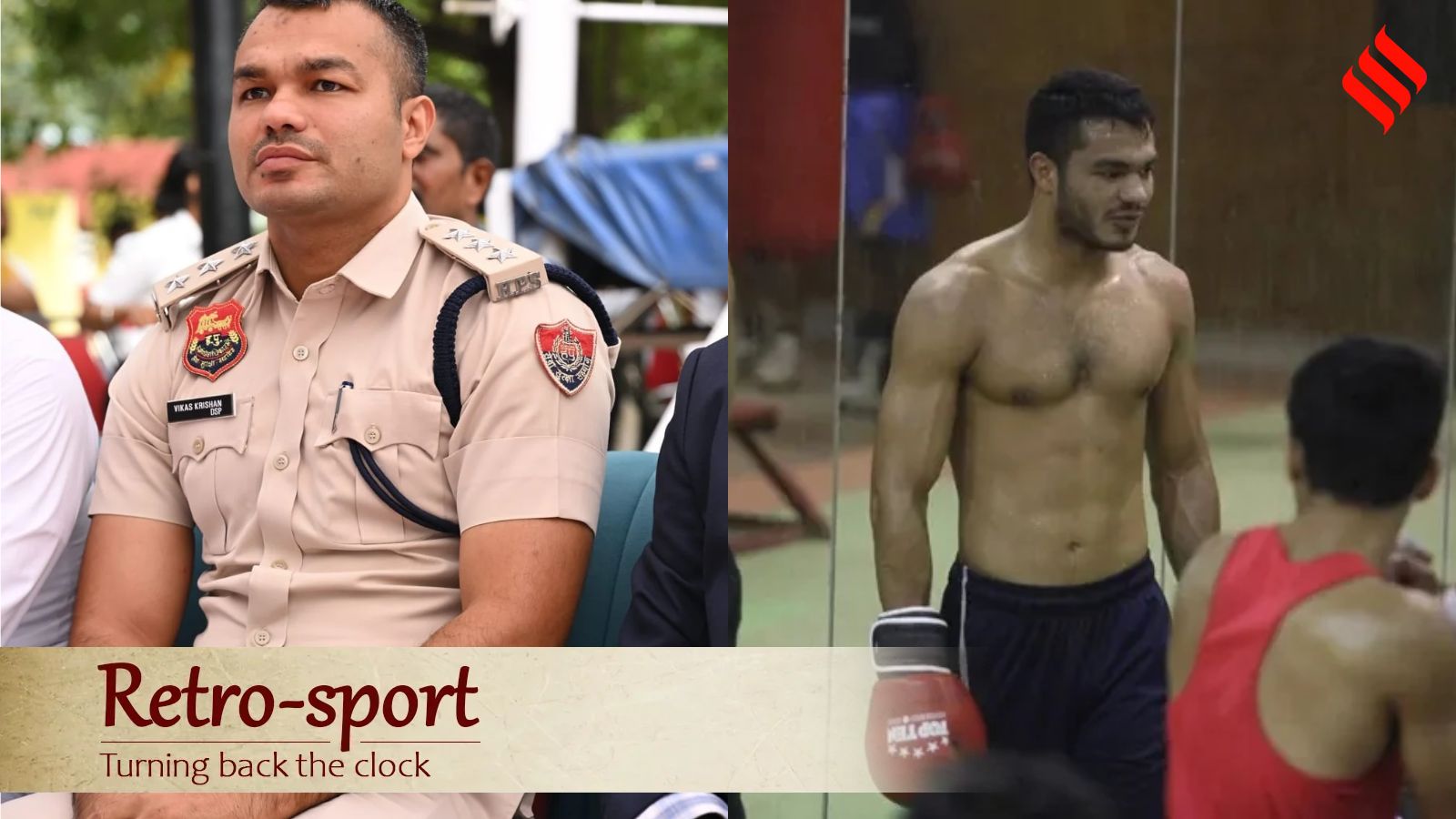


Retro-sport: Vikas Krishan, who trawled internet cafes in 2008 to learn defensive boxing, while other teens played Solitaire
At 18 on November 25, 2010 at Guangzhou Asian Games, India thought it had discovered the next boxing star after Vijender. Vikas Krishan Yadav won gold to beat Dingko Singh's record, but then boxing rules changed and he confesses he remained too laidback and indisciplined to win an Olympic medal
At the 2010 Guangzhou Asian Games 16 years to this day, November 25, the then-18-year-old Vikas Krishan Yadav became the first Indian boxer to win the Asiad gold after Dingko Singh in 1998 at Bangkok. He also broke the Manipuri legend’s record of being the youngest Indian.
His 5-4 tactical win over home boxer Chinese Hu Qing in the men’s 60kg final at the Lingnan Mingzhu Gymnasium in Foshan was two years after Vijender’s Olympic medal, and Vikas had looked like ushering in an era of Indian surge in the ring – before the scoring changes, pegged India down. More crucially, he had perfected the closed guard defensive technique while India had been seduced by Akhil Kumar’s bravado of lowered guard two years earlier.
Yadav still remembers the exact words of his coach Jagdish Singh, who also happens to be the coach of Beijing Olympics bronze medallist Vijender Singh, on the night before the final.
“Hu was the reigning Asian Games champion. Jagdish coach sahib told me, ‘Beta, puraana patta girta hai toh hi nayaa patta ata hai (When an old leaf falls, then only a new leaf comes)’. I knew it was my chance to repeat Dingko sir’s feat, a boxer whom I admired,” shares Yadav while speaking with The Indian Express.
Defense learnt in ring and cyber cafes
Yadav, who had won the World youth title and World Youth Olympics bronze months prior to the Asian Games title in 2010, takes his mind back to 2008, when he would visit the internet cafes in Bhiwani to watch and review Beijing Olympics bouts.
The 2011 world bronze medallist would be known for his guard-up approach and defensive tactics throughout his career. It was in those cramped cubicles of the internet cafes that the then-16-year-old thought of making defense his form of attack with the then scoring system based on the winner being decided on points. While others played Solitaire, he learnt ring craft.
“I would take my notebook and I understood it’s all about taking the lead and defending that lead. So why not build the game with the defence approach. In 2009 nationals, I lost to Rakesh Kalaskar and he had made the guard up approach after making a one point lead. That loss again reiterated in my mind about these tactics and we worked on my straight left and straight right punch combination,” recalls Vikas.
Though he won the title, a nemesis in the form of facing a southpaw style, just like him, would haunt him throughout his career. At Guangzhou though he had all the answers.
A 4-2 win against North Korea’s Kim Chol-song, a southpaw like Vikas in the quarters would ensure a medal for the Indian before he faced Uzbekistan’s Hurshid Tojibaev, another leftie. The Indian would dispatch the Uzbek 7-0 and recalls how his laptop sessions once again helped him. “When the draw came, I would watch my possible opponents’ videos on my laptop. Hudanbergenow had defeated Jai Bhagwan earlier in the Asian Championships and I knew I had to land my punches clearly against him and then return to my defense. The Korean was a southpaw and me as a southpaw always faced difficulty against southpaws as we do not have many of those in India. But I knew my speed was better than him and I went in his close range to score.The Uzbek was shorter than me and I knew I had to make my guard work against his punches. His counter punches did not work and I relied on sharper feints,” says Vikas.
The final and a realisation over the years
Coming into the final, Qing had scored a win over Korean Han Soon-Chul, a boxer who would later win the silver at the London Olympics. With Qing being a boxer relying on defensive counter-punching, they were tied at 1-1 after the first round. With the Indian once again relying on his guard up tactics, the reigning champion led 3-2 in the second round before he opted for some low blows resulting in two points given to Vikas and the score being 4-3 in the favour of the Indian after the second round.
The teenaged Indian held on to his defensive tactics till the last ten seconds of the bout and remembers how head coach Gurbax Sandhu’s words made him go all out. “Hu relied on his long range but I too knew I could block him through my guard up tactics. When Hu received the warning, I knew I had to avoid warnings in the third round. Those 170 seconds, I blocked every punch and when Sandhu sir shouted for the last ten seconds, I went on the attack with Hu being puzzled. When the bout ended, Sandhu sir showed thumbs up and shouted, “Puttar, tu jeet gaya,” he recalls.
Post the Asian games glory, Vikas was appointed DSP in Haryana Police, one of the youngest in state’s history.
Over the years, he featured in three Olympics – a maiden 15-11 loss against USA’s Errol Spence after a review decision with the Indian winning 13-11 was overturned controversially.
Vikas would step away from the game for close to two years before he made a comeback. In Rio, he moved up to 75kg and lost in quarters to eventual silver medallist Bektemir Melikuziev of Uzbekistan 0-3 in the new five-judge ten-point must scoring format.
In 2018 CWG, he became only the second Indian after Mary Kom to win Asian Games and CWG title with his 75kg title before he qualified for Tokyo Olympics. That was brutal – an opening round loss against Quincy Mensah Okazawa of Japan.
“Firstly, if I knew and had worked on how to box against southpaws, I would have achieved more. I did add a left cross in my armour after Rio. I suffered an injury days before Tokyo in my shoulder. Also I was never a disciplined boxer. It was only in 2017, when I stayed with wrestler Paramjit that I realised the importance of discipline. Yes there is a hurt of missing out on an Olympics medal but then to be in the list of legends like Padam Bahadur Mall sir, Captain Hawa Singh sir and Dingko Sir is my biggest reward,” Vikas says.