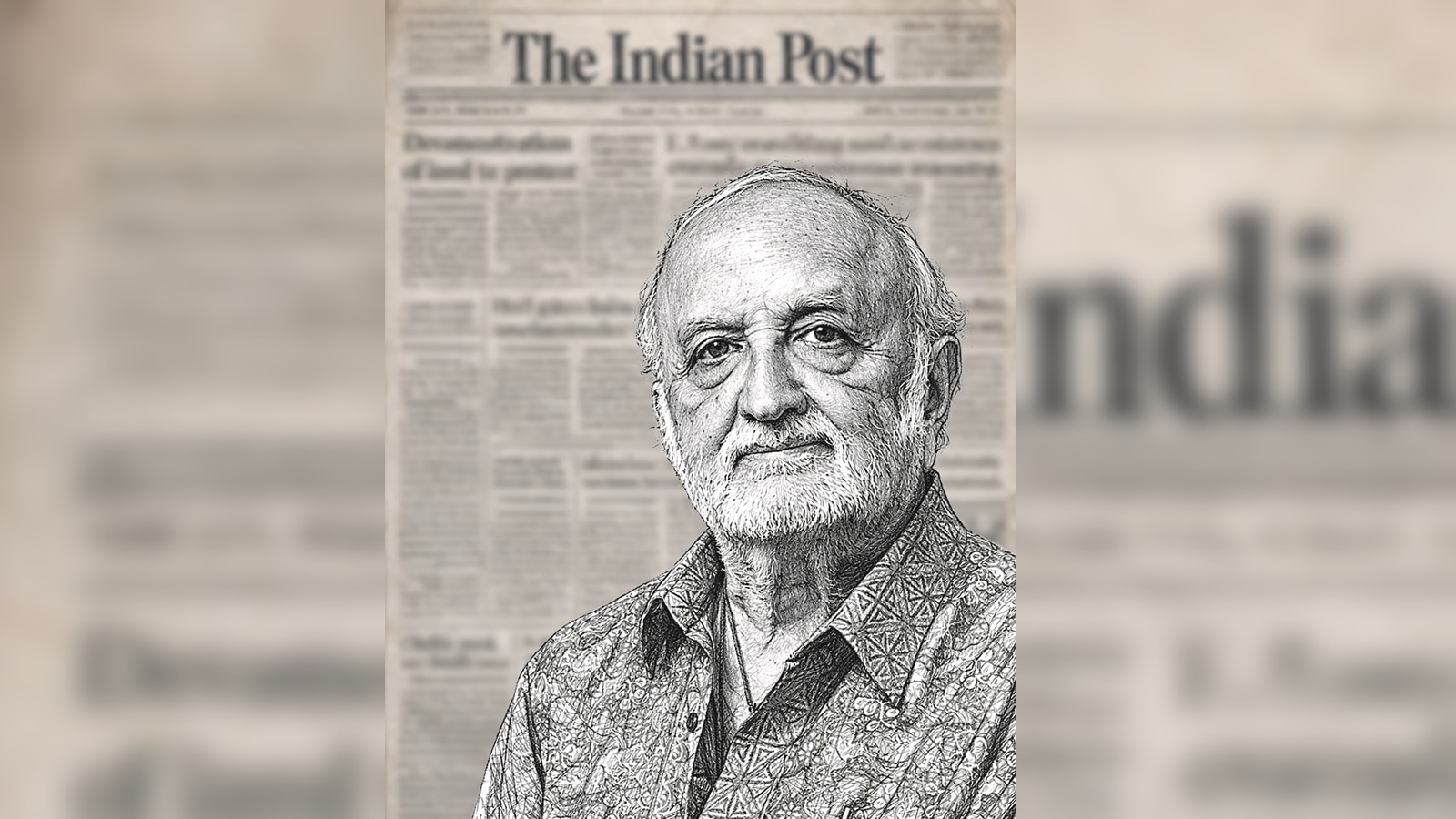


Vijaypat Singhania and his thwarted newspaper dream
Most of the write-ups on Singhania ignore another hat which he wore proudly, albeit briefly, as the founder and owner of The Indian Post, a respected Mumbai newspaper.
Obituaries of Vijaypat Singhania mention the multiple roles of the charismatic industrialist. A successful businessman, record-breaking balloonist and pilot, adventure-sport lover and author, Singhania embodied the slogan of his popular Raymond suiting advertisement, “The Complete Man’’. His hero was J R Tata, also a successful industrialist and aviator known for his ethical business practices. Singhania’s brutally candid autobiography, An Incomplete Life, is a confession of his complicated personal life, including unfairly disinheriting his elder son, and the King Lear-like tragedy in his last years, when his younger son Gautam stabbed him in the back and evicted him from his palatial residence, compelling him to stay in rented accommodation.
Curiously, most of the write-ups on Singhania ignore another hat which he wore proudly, albeit briefly, as the founder and owner of The Indian Post, a respected Mumbai newspaper which operated from 1987 to the early 1990s. My connection with Singhania was during his time as The Indian Post’s proprietor when I headed its Delhi bureau. He was an honest owner with an old world sense of honour, who loved a challenge and was open to new ideas. I respected him for that. His desire to start a newspaper emanated from his love for a journalist and a firm belief that his city needed a better newspaper. He chased his dream, despite the enormous expense and well-entrenched competition. The reservations of the Singhania clan, who control a huge industrial empire, did not deter him.
As shrewd Marwari businessmen his relatives understood that an outspoken publication would inevitably invite trouble with the government. My former The Indian Express editor, Nihal Singh, who was The Post’s first editor-in-chief, invited me to join. I hesitated as I had been warned that Singhania could be impulsive and short tempered. Besides, I could not leave my job as The Sunday Mail news editor immediately. But when the Raymond group’s Delhi chief, Faiz Ali, insisted I meet Singhania, I complied. The industrialist was curious because apparently people claiming proximity to then Prime Minister Rajiv Gandhi had warned him not to hire me as I was close to President Zail Singh, with whom Gandhi had a bitter ongoing spat. Singhania told me it was the first time in his career that he had ever been told whom not to hire, and he would not be dictated to. He also appreciated my work ethic in giving my previous employer notice, as that meant I would show him the same courtesy.
My new office in Connaught Place was the swankiest and most spacious one I had ever worked in. True to his promise, Singhania never interfered in the newspaper’s editorial content. Nihal Singh left as editor and Vinod Mehta took over, not because of differences over the newspaper’s political line, but because Singhania assessed correctly that a new paper needed to be less staid and more newsy and innovative. The Post started to make a mark in both Mumbai and Delhi’s power circles. Shortly before the 1989 elections, a shaken Mehta telephoned me one day to inform me in confidence that Singhania was being pressured by his kin. He had handed Mehta a list of people close to the PM on whom no investigative stories should be done. It included hotelier Lalit Suri and Gandhi’s close friend Satish Sharma.
As luck would have it, within days, C R Irani, owner of Kolkata’s The Statesman newspaper, at a press conference levelled serious charges against Sharma. The Delhi bureau covered the story, but it was a sub-editor on the Mumbai news desk, clearly not in the loop, who overenthusiastically splashed the press conference as the newspaper’s first lead. I realised immediately that The Indian Post’s days were numbered. Officially, the paper was sold to a penny-pinching Gujarati newspaper chain, the very opposite of Raymond’s free-spending style. Soon afterwards, almost the entire journalist staff left with Mehta to start a rival newspaper to be launched by the city’s premier media house, which frowned on competition on its home turf. Singhania conveyed to me through Ali that he would appreciate it if I stayed on. I had no choice but to honour my word to a gentleman owner, much to Mehta’s annoyance at that time.
The writer is contributing editor, The Indian Express