

Vijay’s electoral promises in Tamil Nadu mirror others, but where is the ideology?
In a state where the ruling party is writing its electoral case in the language of rights, growth, and institutional delivery, arriving with a borrowed welfare model and an unshakeable fan base is a beginning
By Vignesh Karthik KR
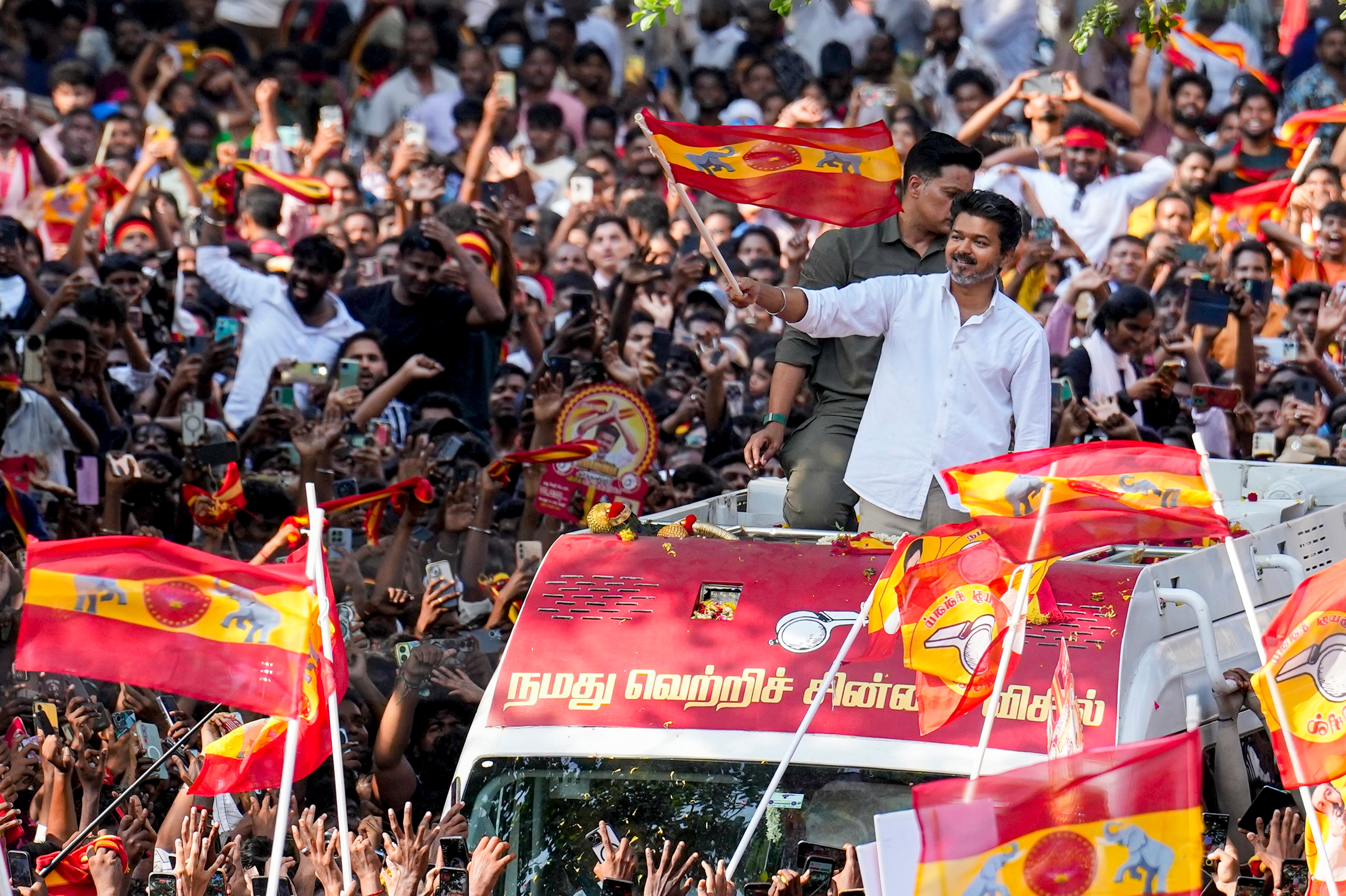
In the trailer of his unreleased film Jana Nayagan, Vijay says two useful things. He is coming. And he has no intention of going back. Both statements are, by now, politically revealing, not as declarations of strength, but as admissions of the only real asset TVK actually possesses going into April 23: The unwavering investment of a fan base that has decided to believe him.
The question Tamil Nadu’s electorate is now quietly asking is simpler and harder than it looks. Is that enough? TVK’s manifesto, released alongside the party’s candidate list, offers some evidence yet of how hollow the ideological cupboard has become. The welfare promises, monthly allowances for women heads of households, free LPG cylinders, gold and sarees for marriages, are lifted almost wholesale from the YSRCP playbook that Jagan Mohan Reddy ran in Andhra Pradesh, including the same familial idiom: The leader not as politician but as elder brother, as provider, as someone who takes personal responsibility for the household. Jagan called it Navaratnalu. Vijay pitches it as a guarantee for the people. The vocabulary is different; the architecture is identical — a direct emotional transfer between leader and beneficiary, bypassing party, bypassing ideology, bypassing the question of how any of it gets paid for.
This is not a coincidence of political fashion. It reflects a more fundamental problem: TVK has no original ideological content. A party that spent months attacking the DMK for reckless welfare spending unveiled promises that make the DMK’s manifesto look fiscally austere. And the TVK did so without embarrassment, because the audience was never addressed as citizens thinking about the state’s finances. They were being addressed as subjects of a particular kind of political relationship, one built on loyalty, proximity, and feeling rather than on argument or programme.
The DMK, by contrast, has made a different and more ambitious bet in its 2026 manifesto. Beneath the catalogue of expanded schemes — women’s entitlement doubled, health insurance widened, guaranteed pensions institutionalised — runs an economic argument: That Tamil Nadu’s 11 per cent growth rate and its growing share of national GDP create the fiscal room to deepen welfare permanently, that redistribution at this scale is not charity but a structural investment in the society that produces the growth. Whether that arithmetic holds through a second term is debatable. But the bet is an ideological one, rooted in a coherent claim about the relationship between the state, the economy and the citizen. Urimai, entitlement, is not a slogan. It is an organising principle with a 60-year pedigree.
TVK has nothing equivalent. Its welfare announcements are not embedded in any larger claim about what kind of society Tamil Nadu should be, or how it gets there. They are numbers at a rally.
Vijay contesting from two seats, Perambur in Chennai and Trichy East, is, in itself, a sensible tactical decision. Rules permit it, and for a debutant party chief whose own win is necessary to retain credibility and hold the organisation together, hedging the seat bet is not a sign of weakness. It is basic political arithmetic. What it reveals is that even at this late stage, the strategic frame is still protective rather than expansionary. TVK is managing its leader’s electoral safety rather than projecting outward confidence.
The deeper problem remains structural. A candidate list assembled partly from television personalities, overnight AIADMK defectors, and inner-circle loyalists is not a second-rung leadership. It is a managed entry. The party that announced it had reviewed thousands of applications produced a slate in which the most recognisable names are either celebrities or turncoats. That gap, between the scale of Vijay’s following and the thinness of the organisational layer he has actually built, is what will determine whether TVK survives as a political force after April 23, whatever the vote count.
Tamil Nadu has always distinguished between a mass following and a political machine. Vijay has the first. He has not yet demonstrated the second. In a state where the ruling party is writing its electoral case in the language of rights, growth, and institutional delivery, arriving with a borrowed welfare model and an unshakeable fan base is a beginning. It is not yet politics.
Whether it becomes one is the only question about TVK that actually matters now.
Karthik KR is a postdoctoral research affiliate at the Royal Netherlands Institute of Southeast Asian and Caribbean Studies, Leiden, and a research affiliate at King’s India Institute, King’s College London