

US birthright citizenship ruling changes less than Indians may hope
The growth of anti-immigrant sentiment both within the current administration and in American society is disturbing, especially since the United States is a land of immigrants barring the marginalised native American population
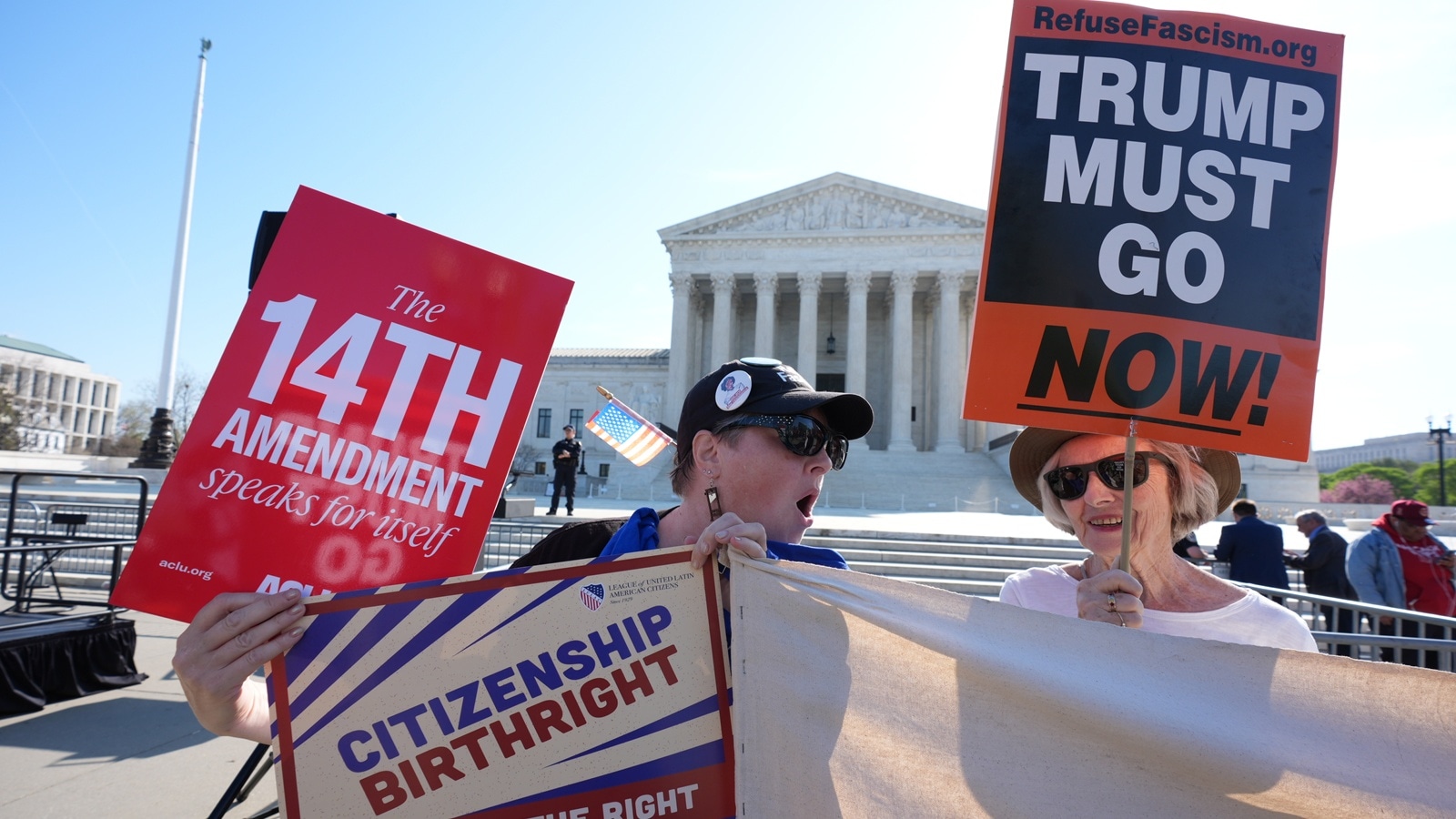
In a 6-3 ruling, the United States Supreme Court has upheld the constitutional commitment to birthright citizenship, thereby affirming the Fourteenth Amendment to the American Constitution. Under its terms, any child born in the United States (except for those of foreign diplomats), regardless of the citizenship status of the parents, is deemed to be an American citizen. The decision, from a Supreme Court that has given the US President a series of legal victories, came as a major blow to Donald Trump, who has been railing against this constitutional right.
Trump’s hostility to this right stemmed from his stated commitment to limit immigration, both legal and illegal, to the US. More specifically, he was hostile to the principle of birthright citizenship because he and several of his advisers argued that it was being routinely abused. In their view, pregnant women from any number of countries were deliberately traveling to the US to give birth to their children in order to obtain American citizenship for them.
The evidence for such claims is scant. For example, of the 3.6 million children born in the US, a mere 9 per cent or 320,000 were born to parents who were illegal immigrants or had temporary protection as their immigration status was being adjudicated in US courts. These numbers hardly constitute a surge and, in any case, the mothers of most of these babies were already in the US, whether legally or otherwise. They had not specifically come to the US to give birth. Trump, who rarely accepts political or legal defeats with good grace, is now appealing to Congress to introduce legislation to override the decision.
The prospects of any such legislation, which would require a constitutional amendment, are dim at best. To pass it would require a two-thirds majority vote in each of the two chambers, the House and the Senate. Subsequently, three-quarters of the states would have to ratify it. The current or even likely future political maps offer little or no hope for such an outcome. Constitutional amendments are notoriously difficult to pass.
Does this decision have any significance for Indians legally working in the US, who are, nevertheless, not permanent residents or citizens? To some degree. Children of H-1B visa holders born in the US will now remain eligible for American citizenship and will not need to fret about their status.
That said, the administration is unlikely to relent in its pushback against immigration. Despite pleas from the Government of India as well as American firms, it has not relented on the high fees that it imposed on American employers. As of September 1 of last year, American employers wanting to bring in a worker from abroad on the H-1B visa programme will be compelled to pay $100,000. Since India was the recipient of close to 70 per cent of these visas, the impact on prospective Indian visa seekers will be disproportionate. A federal judge struck down the order in June, declaring it to be an unlawful tax that can only be imposed by Congress, but the Trump administration will appeal the decision.
Beyond the issue of citizenship and visas, Indians and even Indian Americans have cause for concern. Systematic statistical data on hate-related crimes against them is not readily available, but according to a recent, reliable survey, as many as 27 per cent of Indian Americans feel that they are now the objects of discrimination while 25 per cent of permanent residents reported the same sentiment. Since this was a nationwide sample, it does not reveal regional variations. Some anecdotal evidence, however, suggests that even in America’s Silicon Valley, hostility towards people of Indian origin working in the high technology sector is growing.
The rise of anti-immigrant sentiment both within the current administration and in American society is disturbing, especially since the US is a land of immigrants, barring the marginalised native American population. Sadly, hostility to immigrants is not new in the US. In the mid-19th century, in the wake of the Irish potato blight, thousands of impoverished immigrants turned up on America’s shores, and faced blatant discrimination and hostility when they landed in major urban centres such as New York City. Such attitudes persisted for years before people of Irish origin were assimilated into American life and society.
Compared to those of Irish descent, Indian Americans are a small fraction of the American population. There are nearly 40 million who are of Irish ancestry, while there are slightly over 5 million Indian Americans. Yet, as recent immigrants who are non-white and mostly of other faiths — as opposed to the numerically dominant Christians — they can easily become the object of scapegoating. Common tropes suggest that anti-immigrant sentiment toward Indian Americans stems from the belief that they are unfairly seizing job opportunities and are abusing the visa system. Sadly, the current administration has done little to quell these fears and has instead fanned them. Though profoundly disturbing, hopefully these sentiments are only the latest version of anti-immigrant bigotry and will abate over time.
The writer is a senior fellow and directs the Huntington Programme on US-India Relations at the Hoover Institution, Stanford University