

Shashi Tharoor writes: Why an 850-seat Lok Sabha threatens Indian democracy
An oversized legislature where the vast majority of members have no voice suits an executive that prefers compliance over scrutiny
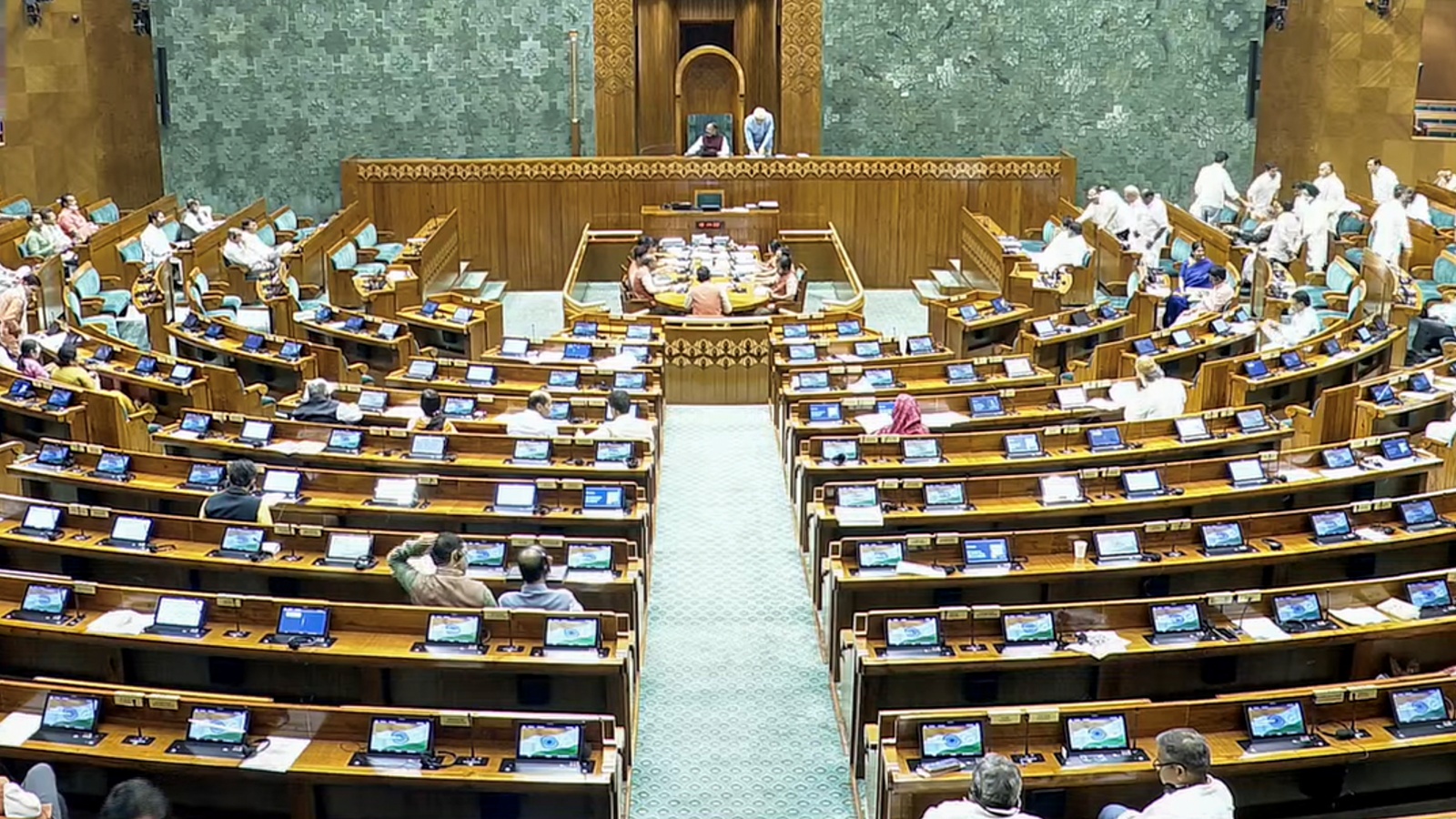
The government’s seeming determination to proceed with a revised delimitation that drastically increases the size of the Lok Sabha to 824 or 850 seats marks a disastrous watershed in India’s institutional architecture. The underlying justification offered by the government is purely mathematical: The size of the Lower House cannot remain frozen at the 543-seat limit established in 1972, since when the nation’s population has more than doubled. Yet, beneath this seemingly democratic argument lies a profound hazard.
Amid all the other major challenges of the looming delimitation exercise — notably the severe political and federal friction caused by penalising southern states for successful population control, while disproportionately rewarding the northern Hindi heartland for its failures — a basic question remains unaddressed: Does it make any sense to have a legislature so massive and structurally unwieldy? No established democracy does.
Every mature democratic system recognises that a Parliament must be capped at a size that permits genuine legislative scrutiny, cohesive debate, and individual member participation. By choosing to push the Lok Sabha towards 850 seats (a size no other democratic legislature has), India is charting an anomalous and dangerous course. Democratic theory and global practice consistently show that beyond a threshold, a legislature ceases to function as a deliberative body and deteriorates into a chaotic colosseum where only a select few can speak, while the rest are reduced to passive spectators, mere numbers on voting machines.
After all, the United States House of Representatives was legally capped at 435 in 1929, when the United States population stood at 120 million. Today, the American population has tripled to over 335 million, yet the size of the House remains at 435. Americans recognise that increasing the number of representatives to match population growth would paralyse the legislative process. Instead, each member simply represents a larger number of voters, relying on robust local staff, modern communication, and a highly organised committee system to bridge the governance gap. Indian MPs can do that too.
The realities of an 850-member Lok Sabha are devastating for individual legislators. In a standard parliamentary session, time is an unyielding, scarce resource. Consider the daily Question Hour or a standard legislative debate on a complex bill. If a debate is allocated four hours, and time is distributed according to party strength, at most 15-20 MPs out of 850 will be able to participate. In practice, backbenchers and members of smaller parties will be mostly silenced.
With an oversized Parliament, a vast majority of MPs will never get to ask a question, initiate a private member’s bill, or participate in a substantive debate during their entire five-year tenure. They will be transformed into silent placeholders, raising their hands when the party commands. This will worsen an already distressing trend in Indian governance: The shrinking role (and systemic degradation) of Parliament. In recent years, the number of days Parliament meets annually has steadily declined, bills have been passed via voice vote within minutes without standing committee scrutiny, and the Opposition is frequently sidelined. Flooding the chamber with hundreds of additional members will accelerate this marginalisation, burying quality under the sheer weight of quantity.
An oversized legislature where the vast majority of members have no voice suits an executive that prefers compliance over scrutiny. When a Parliament becomes too large to debate, it naturally cedes its oversight power to the executive cabinet. The individual lawmaker loses leverage, and the House is reduced to a notice-board and a rubber-stamp.
This structural transformation bears an ominous resemblance to the authoritarian legislative model in Beijing or Pyongyang. Specifically, an 850-seat Lok Sabha risks becoming a desi version of the Chinese People’s Political Consultative Conference or the North Korean Supreme People’s Assembly — enormous, unwieldy bodies designed to look grand, representative, and pluralistic, but reduced to applauding set speeches by the Great Leader. Their sheer size guarantees they cannot engage in real legislative negotiation or challenge the ruling executive. They exist to perform consensus, not to build it through debate. If India builds a massive legislature where MPs are stripped of their voices due to the arithmetic of time constraints, it will have successfully hollowed out its democracy, replacing a vibrant deliberative body with a performative pageant. Far better to save the extra expenditure on salaries, accommodation, travel and pensions for 300 more MPs and instead build a serious office building for the existing MPs near Parliament, as every other democracy provides its legislators.
The government’s primary defence — that a single MP cannot effectively represent two to three million citizens — is a fallacy that misinterprets the role of a national lawmaker. An MP’s constitutional duty is national legislation, foreign policy, macroeconomic governance, and holding the Union executive accountable. They are not municipal councillors or MLAs. If India established a sharp, institutional demarcation between the roles of Members of Legislative Assemblies (MLAs) and Members of Parliament (MPs), a smaller, focused group of MPs could easily represent large constituencies. Local grievances, municipal infrastructure, and civic amenities fall squarely within the domain of state legislatures and local panchayats or municipal corporations under the 73rd and 74th Amendments; as population increases, expand the number of MLAs! If local governance frameworks are empowered, the local citizen does not need to look to an MP for everyday civic needs. By keeping the Lok Sabha compact and focused on national governance, and leaving localised representation to state and municipal levels, India could maintain a highly efficient, effective, and truly participative federal structure, without ruining the functionality of Parliament.
The proposal to expand the Lok Sabha to 850 would create a House that is not a forum for governance but an echo chamber for the government. As we contemplate the future of our democracy, we must realise that true representation lies in the quality of debate, the rigour of legislative committee scrutiny, and the empowerment of local levels of government — not in creating an unwieldy mega-chamber that replaces democratic discourse with empty theatre.
The writer is a fourth-term Congress MP from Thiruvananthapuram