

For India, weakening monsoon and fertiliser crisis, a double whammy
India needs to source nearly four times its current urea opening stocks to meet kharif requirements, and that gap must be bridged through imports purchased at crisis-level global prices
India’s fertiliser problem has quietly changed character. For the first several weeks after Iran effectively closed the Strait of Hormuz in the aftermath of the US-Israel strikes in late February, the dominant anxiety in New Delhi was physical: would the fertilisers arrive, and in time? That question has not disappeared, but it has been substantially overtaken by a harder one. With the critical Kharif sowing season beginning in June, the real issue is no longer whether India can source enough fertiliser but whether New Delhi can keep paying for the guarantee that it will.
India’s fertiliser production declined 24.6 per cent in March 2026 over the same month last year, the sharpest single-month contraction in recent memory, after output had actually expanded for three consecutive months prior. This reversal matters less as a logistics problem than as a fiscal signal. The government has already committed to absorbing the cost of guaranteeing supply, and if the Gulf conflict endures, that commitment may prove open-ended in ways the fiscal budget cannot easily accommodate.
The mechanism of disruption is not complicated. Natural gas is the primary feedstock for urea, India’s most widely consumed fertiliser, and the Gulf region supplies nearly 50 per cent of India’s LNG imports alongside a significant share of its urea requirements. When the Strait of Hormuz narrowed to near-closure, domestic urea plant output fell from its usual 2.5 million tonnes per month to 1.5 million tonnes in March. Import prices for urea nearly doubled, while the price of diammonium phosphate (DAP), a phosphorus-rich fertiliser that is the second-most widely used in India after urea, rose by up to 50 per cent. It was both a supply disruption and a price shock simultaneously, each amplifying the other.
With the sowing season peaking in June, allowing farm input costs to rise visibly would risk both food price inflation and a damaging squeeze on agricultural incomes at precisely the wrong moment in the crop calendar. New Delhi’s response was swift, and on April 8, the Union Cabinet approved a roughly 12 per cent increase in the nutrient-based subsidy for the Kharif 2026 season, while keeping the retail price of DAP flat.
The April hike is not an isolated intervention. The subsidy bill had already exceeded the Union Budget’s revised estimates for FY26 by February, before the war in West Asia materially affected the numbers. The FY27 budget had provisionally allocated ₹1.71 trillion for fertiliser subsidies across the full year, a figure premised on some normalisation of global prices, not a prolonged military conflict over one of the world’s critical maritime chokepoints. That assumption has not aged well.
The demand-side context makes this a bit more uncomfortable. India needs to source nearly four times its current urea opening stocks to meet Kharif requirements, and that gap must be bridged through imports purchased at crisis-level global prices. Each additional tonne represents a subsidy liability the exchequer bears, not showing up as a price rise at the farmgate but materialising as fiscal pressure on the government’s books. The subsidy mechanism, by design, converts this supply shock into a spending shock. The question is whether that spending shock is bounded or open-ended, and right now the answer depends almost entirely on how long the Strait remains inaccessible.
A third of the world’s fertilisers normally transit the Strait, and unlike oil, there is no strategic reserve architecture or mature alternative routing. Even in an optimistic scenario, restarting production and transport after any reopening could take weeks. India has moved to diversify sourcing, with six new urea plants that have added 7.6 million tonnes of annual domestic capacity in recent years. While these are meaningful additions, the scale of the current disruption is testing buffers designed for normal volatility rather than a prolonged closure of a critical global chokepoint.
Compounding this is the monsoon outlook. On April 13, the India Meteorological Department forecast below-normal rainfall for the 2026 southwest monsoon season at 92 per cent of the Long Period Average, the first such forecast in three years, driven primarily by the expected development of El Niño conditions between June and September. For Kharif crops such as paddy, cotton, pulses, and oilseeds, the second half of the season is precisely when El Niño’s effect is expected to be sharpest and when standing crops are most water-dependent. Therefore, India is now navigating a fertiliser supply shock and a weakening monsoon in the same crop season.
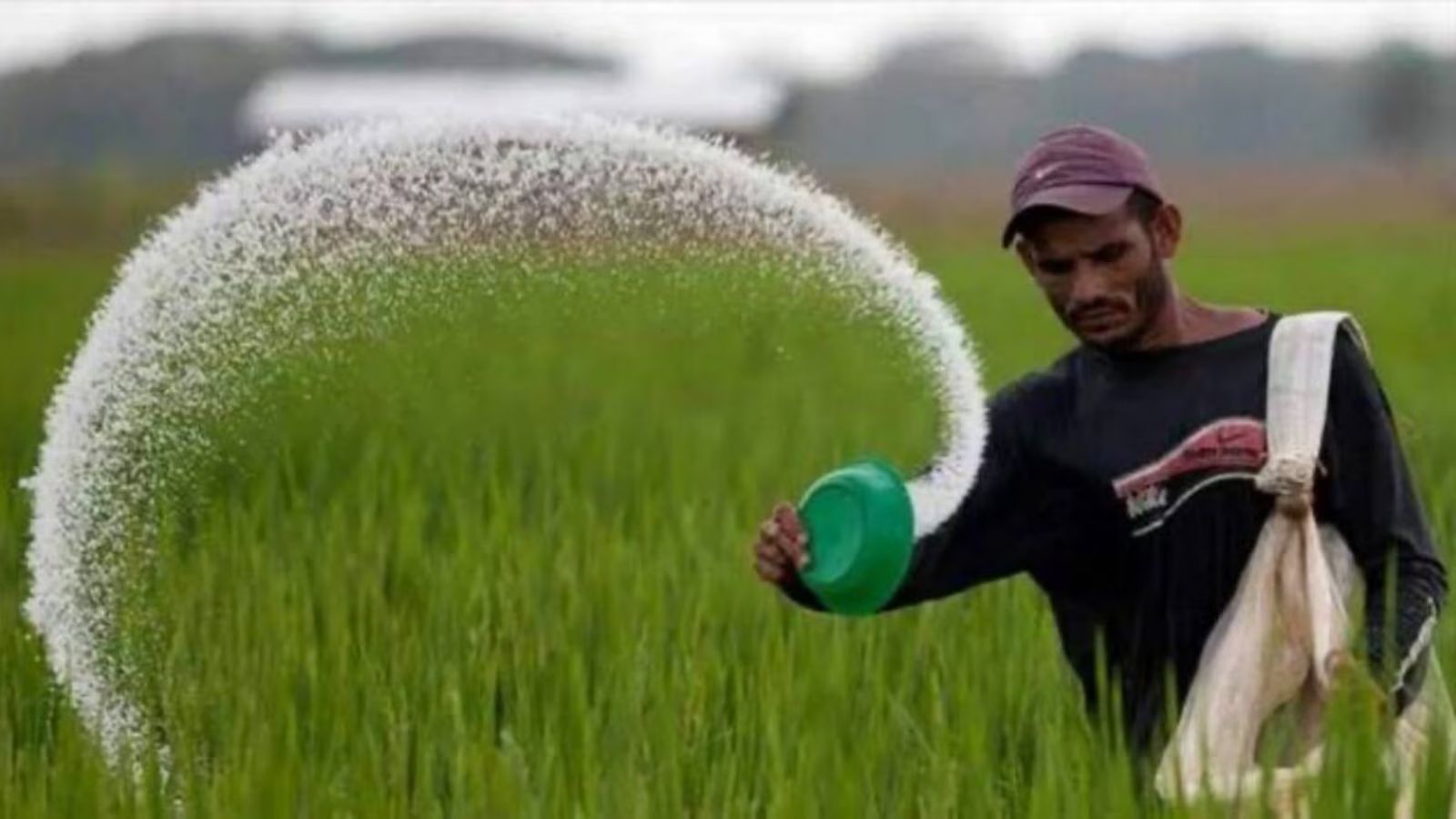
The consequences are already visible in how farmers are adjusting. When input availability is uncertain, farmers tend to shift away from fertiliser-intensive crops, reduce application rates, or delay planting until stocks arrive. These are individually rational responses that can collectively weigh on yield outcomes and rural incomes. Stable farmgate prices help maintain confidence, but they cannot fully substitute for timely and adequate input supply on the ground.
The stakes extend beyond the domestic balance sheet. Sustainable Development Goal 2, the UN’s Zero Hunger goal, is a 2030 target the world is already struggling to meet. India’s position on this goal is one of visible progress, shadowed by persistent vulnerability: the country has reduced its undernourished population from 243 million in 2006 to around 172 million today, yet it still ranks 102nd out of 123 countries on the 2025 Global Hunger Index. For a country of India’s scale, any season that compresses agricultural yields may not reverse the trajectory on SDG 2, but it makes the road towards sustainable development measurably harder.
This is where the broader policy question takes shape. Absorbing rising global fertiliser costs through the subsidy system is a well-established instrument of agricultural price stability in India, and its role in protecting farm incomes is not in dispute. The more pressing question is structural: how long can that absorption continue if the Gulf conflict persists, and what combination of supply diversification, demand-side efficiency, and domestic capacity expansion can reduce India’s exposure over time?
The Strait of Hormuz has concentrated into a single chokepoint a set of vulnerabilities that India has managed over the years through import diversification, domestic capacity building, and fiscal support. Each of those instruments is now under pressure simultaneously. The June sowing window will indicate how well the system holds, while the current financial year accounts will tell us what it costs.
The writer is a fellow at the Observer Research Foundation