

Behind CBSE’s On-Screen Marking system failure, a simple fact: Digitisation is not reform
CBSE had already weakened the moderation mechanisms that once helped correct extreme variations between evaluators. The current controversy makes clear that technology has not removed subjectivity or error. It has merely shifted them into a different format
India’s examination system rests on a foundational assumption: That the process is fair, even when outcomes disappoint. Remove that assumption, and the system loses its legitimacy. This year, CBSE has come dangerously close to doing exactly that.
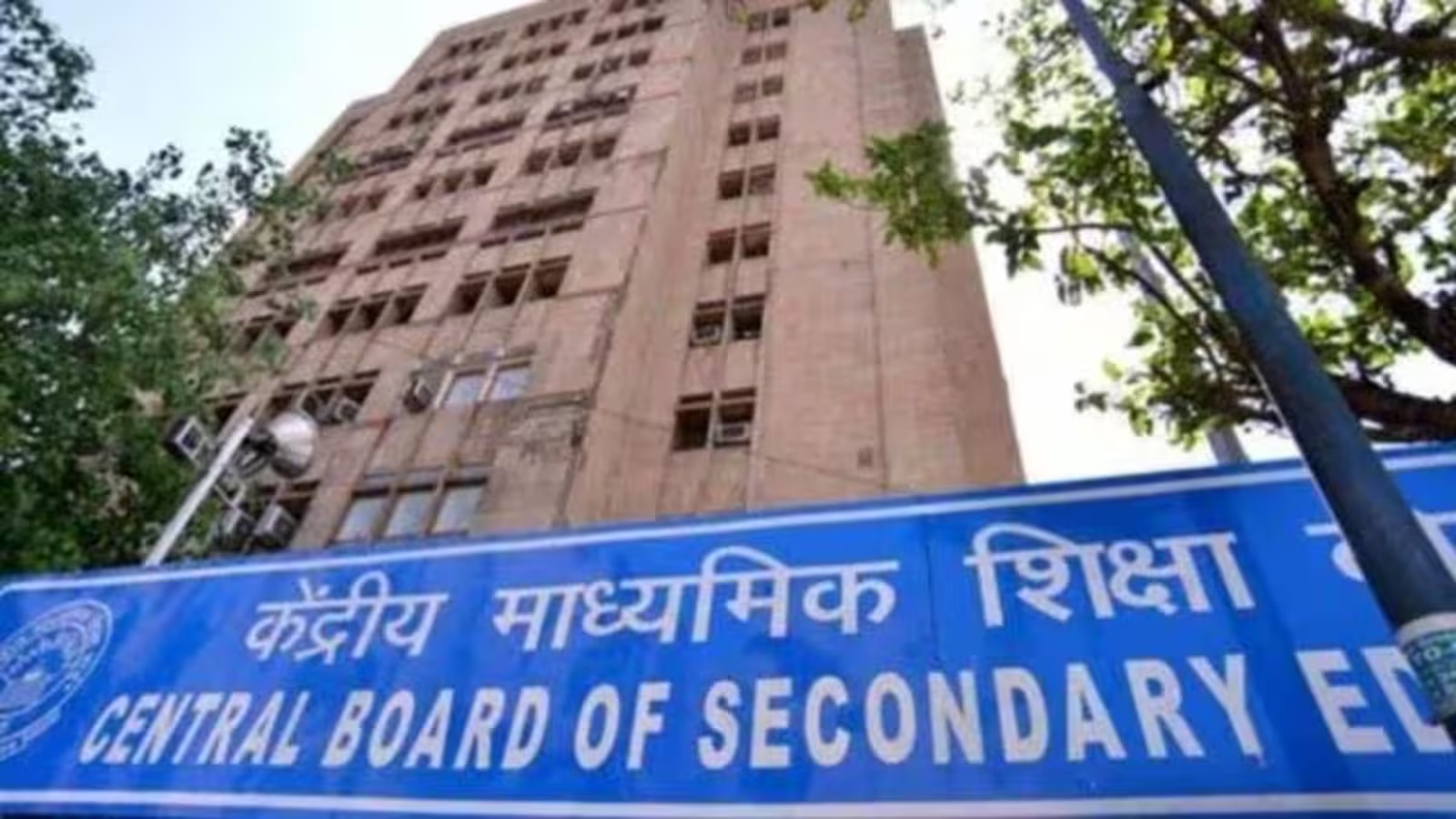
The Class 12 results declared on May 13 sparked a controversy that went well beyond routine post-result grievances. Thousands of students reported marks that were sharply inconsistent with their preparation and school performance, particularly in Physics, Mathematics, and Accountancy. Large numbers of answer scripts had to be rescanned and manually reviewed. Teachers’ organisations raised concerns that examiners had received inadequate training on the new On-Screen Marking (OSM) system.
Then came the allegation that crystallised public anxiety. A student who accessed his Physics answer sheet claimed the handwriting was not his and that the uploaded script belonged to someone else. Although the matter was resolved soon after, it laid bare the inadequacy of the system and revealed how fragile institutional trust has become. This is not merely a technical controversy. It is a credibility crisis in one of India’s most consequential public institutions.
At the centre of the storm is CBSE’s On-Screen Marking system, introduced this year on a massive scale. The technology was presented as a reform that would standardise evaluation, improve efficiency, and reduce inconsistency. But digitising evaluation is not the same as reforming it. The answer scripts remained the same. The high-stakes nature of the examination remained the same. The opacity surrounding the assessment remained the same. Only the medium changed — from physical scripts to scanned screens — and that change itself carried real pedagogical costs. Evaluating long, handwritten descriptive answers on a screen is not the same as reading them on paper. Examiners had to scroll through dense responses for hours under strict timelines. In subjects requiring interpretive and nuanced judgment, this arrangement can easily render evaluation mechanical, encouraging keyword-based marking over careful academic assessment. Technology can assist evaluation; it cannot replace the intellectual responsibility that fair assessment demands.
The institutional response has only deepened the problem. As usual, the CBSE initially downplayed irregularities before eventually acknowledging the need for rescanning in many cases. That the Indian Institute of Technology, Madras, was called in to assist in ensuring a “glitch-free re-evaluation process” only after the controversy had escalated speaks volumes. It confirms that the CBSE was ill-prepared to manage a crisis it had created. Worse, it is a double whammy for students: First, they are aggrieved by their results; then, the very redress mechanism that should have offered them relief rubs salt in the wound. Besides fixing the re-evaluation glitches, ensuring fair and just evaluation in the first place needs to be the focus. Risks should not be managed reactively, but anticipated proactively.
Equally troubling is the CBSE’s assumption that digitisation would eliminate inconsistency in marking. It had already weakened the moderation mechanisms that once helped correct extreme variations between evaluators. The current controversy makes clear that technology has not removed subjectivity or error. It has merely shifted them into a different format.
Meanwhile, the education minister has described the disruption as part of building a new system. But educational institutions cannot run experiments on students whose futures depend on these results. The obligation is to anticipate failure before implementation, not offer explanations after the damage is done.
Sadly, students who came forward with complaints were not spared by troll armies. Perhaps the most telling sign of institutional decay is this. Rather than rectifying errors, the impulse appears to be to cover up and deflect. That is a travesty of justice. The Supreme Court’s remarks that the National Testing Agency (NTA) has not learned its lessons from the NEET leaks apply equally to CBSE. When India’s examination system places enormous pressure on students, and when its results shape careers and futures, it cannot afford this degree of uncertainty and opacity. CBSE’s crisis now is one of trust. Once that erodes, no technology can easily restore it.
The writer is a former professor and dean of a Bengaluru university