

Amid the rubble and ruin, songs of survival
In an attempt to turn art into a survival mechanism for the city’s displaced, starving, and anxious children, a music teacher in Gaza has been harmonising to the sounds of Israeli drones
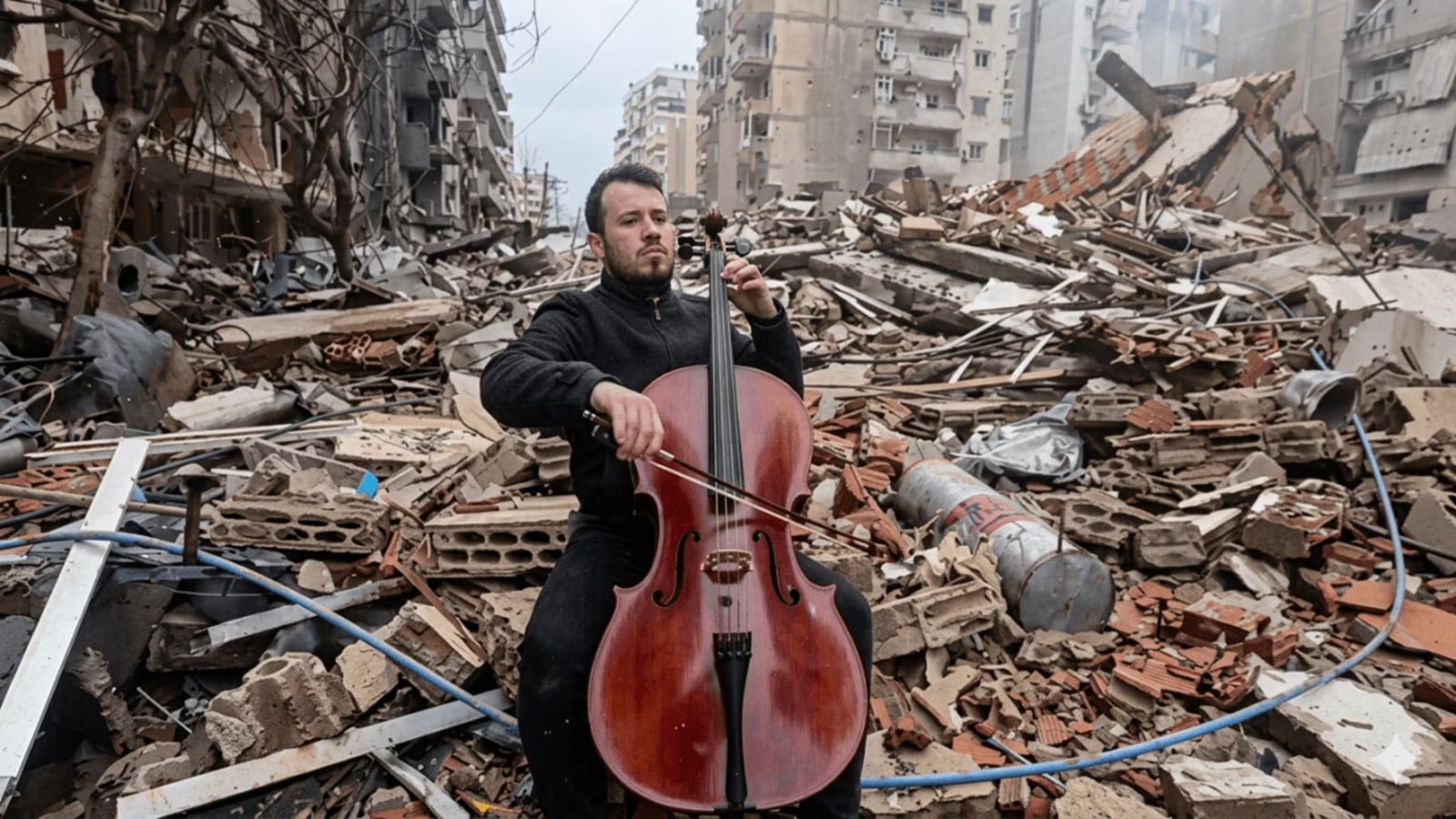
For weeks, 30-year-old Lebanese cellist Mahdi Al Sahily has been sitting amid the ruins of Haret Hreik, a suburb of Beirut, playing his cello. Around him are sliced-open residential buildings, walls hanging at odd angles, wiring trailing across broken concrete, and neighbourhoods reduced to debris. The place has been the target of Israeli strikes for its association with Hezbollah.
Al Sahely, always dressed in black, has sat in what he calls one of his favourite neighbourhoods almost every other day and played Armenian composer Aram Khachaturian’s ‘Andantino’, a tender, evocative piece that once incurred the wrath of Soviet authorities for not being nationalistic enough.
Part protest, part mourning, music, it seems, has decided to stand guard over a conflict-ravaged world. Approximately 50 km southeast of Tehran, in Pakdasht, is the Damavand Power Plant, with the capacity to power 2 million homes, which is where Iranian musician Ali Ghamsari camped on April 7 and played the Persian tar — right after US President Donald Trump’s chilling warning: “A whole civilisation will die tonight”.
Ghamsari stayed put, playing tune after tune, painting a haunting picture of defiance even as young people formed human chains around energy and infrastructure sites. The ceasefire came the next day. What if Trump had decided to have his way?
Can the sublimity of art feel out of place during war? Can it be misunderstood as an escape? After all, war prioritises survival: Staying alive, finding bread, warm clothing, shelter. No form of art will rebuild a wall, patch a roof, or provide clean water and urgent medical attention in Iran, Lebanon, and, for the longest time, in Gaza. What music does is something else: It continues to insist that life and its meaning are not exhausted. During and after the destruction, courageous musicians like Sahely and Ghamsari reintroduce gentler facets of life that war strips away from people.
There are other examples. In 1992, Vedran Smailović, the principal cellist of the Sarajevo Orchestra, carried a chair to the market centre that had been turned into rubble and played Baroque composer Tomaso Albinoni’s ‘Adagio in G Minor’. Twenty-two people waiting for bread in a queue were killed there during a round of shelling. Smailović went there every day for 22 days, paying homage to those who were lost. In 2015, Karim Wasfi, former director for the Iraqi National Symphony Orchestra, sat next to a bombed site in Baghdad and played his cello in protest. Music in Syria’s war-torn streets has been a common sight. In Baltimore in 2015, in the aftermath of riots as a result of the custodial death of Freddie Gray, an African-American man, members of the Baltimore Symphony Orchestra gathered outside Joseph Meyerhoff Symphony Hall and played Bach and Beethoven. One of the most enduring images of war is that of a Russian soldier seated at an abandoned piano in Chechnya, playing amid the wreckage, in 1994.
More recently, in an attempt to turn art into a survival mechanism for the city’s displaced, starving children, a music teacher in Gaza has been harmonising to the sounds of Israeli drones. The children have said they feel less scared when they sing.
It is difficult to gauge the fear that would have hung over Tehran that Wednesday morning. Minutes after the US-Iran ceasefire, Iranian musician Hamidreza Afarideh sat in the ruins of his music school, about 2 km from a military base, playing his kamancheh. “I wanted the last sound that remains here to be music, not bombs and missiles,” Afarideh wrote on his social media.
Let it be remembered that music refused to give up.
The writer is senior assistant editor, The Indian Express. [email protected]