



The Delhi Art Exhibitions guide: What and Where
The India Art Fair might be over but galleries across the Capital continue to host several exciting exhibitions.
Six years after his last solo in the Capital, Atul Dodiya’s exhibition features 12 large oil paintings, developed primarily over the past year. About the exhibition, Dodiya says: “Memory plays on your mind while looking at art. Art evokes a range of thoughts, feelings and emotions. Reliving them, in this hall of mirrors, is a complicated narrative of overlaps. Here are paintings within paintings, viewers watching viewers within the painting viewing paintings in the painting; in real spaces, in the space of the museum, at home and in the artist’s cave of creativity. The artist and the viewer’s perceptions overlap and sometimes separate in a deep dive of incomprehension. It’s an abstract experience. Sadly, nothing remains simple. Happily, everything is complex.”
On till: March 10
Curated by Shreya Sharma, the exhibition that takes its title from the folk verse, “Sut te saah ne rachan meri kahāṇī, Phulkari de phullāñ vich likhi zindagānī” (Thread and breath have woven my story; in the flowers of Phulkari, my life is written) features over 30 rare pre-partition phulkaris and baghs from the private and family collections of designer Amit Hansraj and Brig. Surinder and Shyama Kakar.
On till: February 20
Marking Paris-based artist Sujata Bajaj’s return to Delhi after more than 16 years, this exhibition is also a personal inquiry into the visual and emotional language of the cosmos. Developed over five years, the exhibition draws from her engagement with images captured by the Hubble and James Webb Space Telescopes, where the artist has translated celestial observations into vibrant abstractions-canvases charged with energy, light, turbulence and stillness.
On till: March 1
Part two of a large watercolour exhibition by Natesan, the exhibition, spread over two floors of the gallery, features reflective works of the artist that see him capture the banalities of everyday existence with meticulous attention to light, shadow and atmosphere. The visual vocabulary also explores studies of the self and the other as part of a constant dialogue.
On till: February 26
The two-person exhibition features works by Shanthi Swaroopini (India) and Michal Glikson (Australia), who share formative training at the Faculty of Fine Arts, Maharaja Sayajirao University, Vadodara. Unfolding as evolving archives of gesture and memory, the showcase also finds connections between Swaroopini’s introspective figuration and Glikson’s detailed scroll-based mapping.
On till: March 5
Founded by conservation scientist and creative director Tara Lal and designed in collaboration with T__M.space, the ecological art and architectural project is a conservation and creative arts initiative focussed on renewing public connection with the natural world.
Designed as a structured walk-through installation, made of upcycled Lantana camara wood and inspired by India’s sacred groves, the Pavilion “draws on sacred geometry, movement and material to create a continuous path of light, shadow, texture and sound”.
On till: February 13
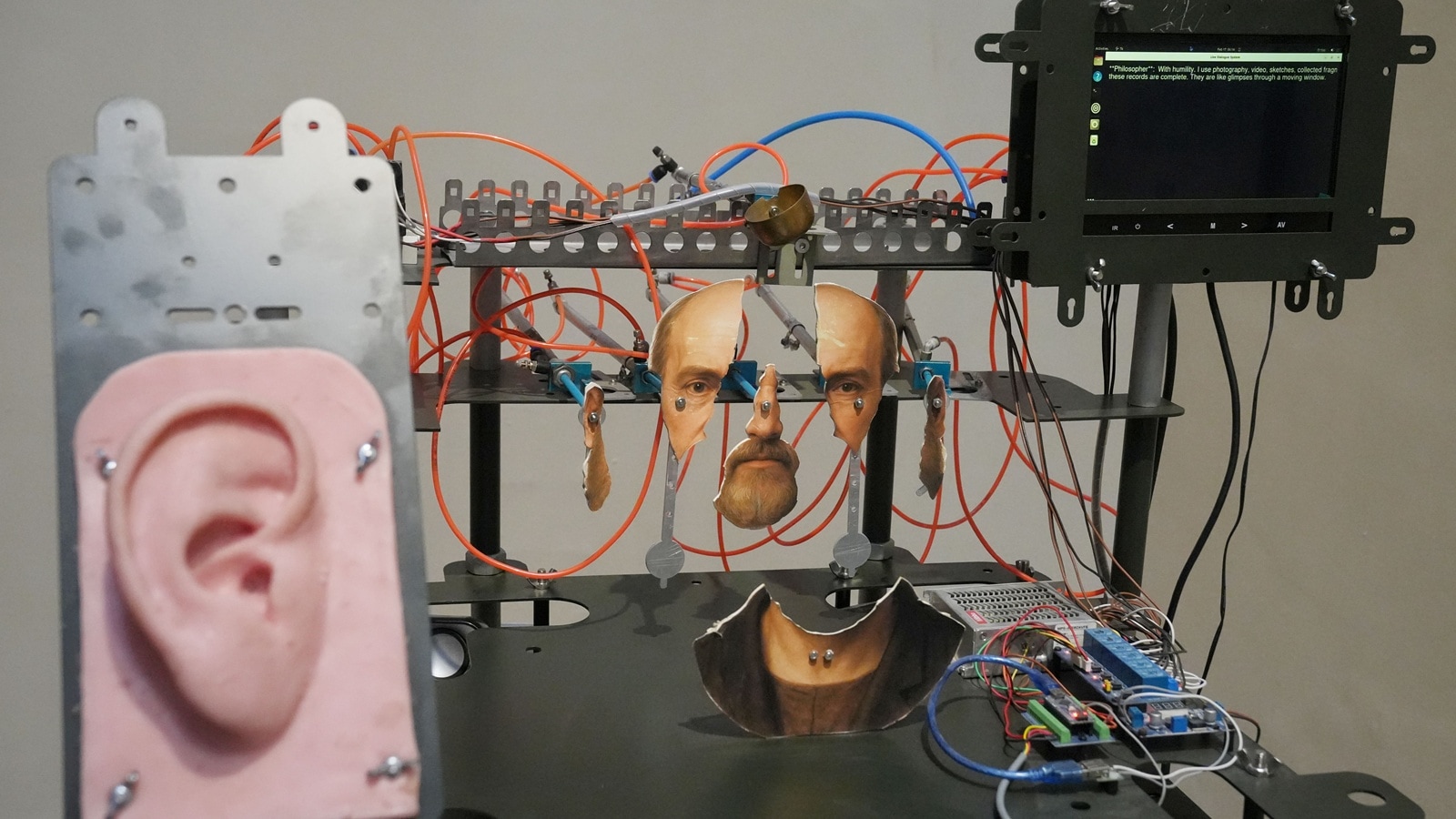
Featuring works of intermedia artists Sukanya Ghosh and Nandan Ghiya, both of whom recently exhibited in the UK — Ghosh at the Royal College of Art and Ghiya at the Liverpool Biennial — the exhibition curated by Rahaab Allana, with scenography by Suryan Saurabh, engages with personal and found archives, examining the idea of the “fragment” as an independent and recurring form, while reflecting on the uncertain journeys and afterlives of images.
On till: February 13
Featuring work by the gallery’s founding director, Peter Nagy, the portfolio of silkscreens are reproductions of works Nagy produced between 1983 and 1991, when he lived in New York. The black and white works cover several mediums, from photo-copies made in unlimited editions to works made as enamel-on-metal signs and acrylic paintings on canvas
The silk screens were published by Fabjbasaglia Contemporary Art of Rimini, Italy, for an exhibition curated by the New York curator Richard Milazzo titled “Sailing to Byzantium: Six New York Artists in Venice” which took place in Venice from December 4, 2025 to January 11, 2026.
On till: February 14.
Curated by Jiten Thukral and Sumir Tagra, in its third year, the project examines the politics and complexities involved in the seemingly simple desire of “the pursuit of sweetness”. A note reads: “Climate change and its profound impacts are understood here in tandem with fruiting cycles, seasonal rhythms, and systems of sustenance. Through this lens, the exhibition traces shifting tastes and conditions, expanding our understanding of the tensions and contradictions inherent in what it means to be a “fruit” within today’s socio-ecological and political landscape.”
On till: February 15.
Being presented by one of Delhi’s oldest art galleries, the highlights of the exhibition include crisscross gouaches of 1950 as well as Souza’s canvases of the 1960s. A note reads, “In these works, we find traces of the profane in his sacred imagery — an impasto void that shadows a red-hooded cardinal and his sins alike; spray-painted figures mutating divine Byzantine icons into apparitions of atomic-age anxiety; frenetic altars of vessels and flesh that confound the sanctity of ritual. And we find traces of the sacred in the profane, where uninhibited and sensual forms — as in the striptease of Henrietta Moraes — are so starkly human that they radiate pre-nativity nakedness and celebrate unapologetic human freedom.”
On till: February 15
This exhibition brings together master artists and artisans working with glass across India’s leading studio glass clusters.
On till: February 25
Featuring works of Neerja Kothari, the 131 durational drawings that are part of the exhibition represent 11 minutes each and together span a full 24 hours. A note reads, “Installed as a continuous sequence, the works trace the shifting rhythms of a day — its intensities, lulls and quiet returns. Like waves, the drawings ebb and flow: some appear stark and insistent, signalling moments of heightened awareness or emotional weight. These points are made more prominent by their numbered notations, marking them as significant anchors in the flow of the day. Other drawings remain soft, diffused, or barely there, echoing the countless minutes that pass gently or unnoticed.”
Featuring works of Bangladeshi artist Mojahid Musa, the exhibition showcases sculptures and paintings informed by an artistic practice that is defined by a meticulous process of textured clay weaving that draws from a rich legacy of clay culture alongside Bangladeshi traditional motifs and folk-art references.
The exhibition of black-and-white photographs by Ketaki Sheth draws from her journeys in the film worlds of Bombay and Madras between 1985 and 1993. The series features young actors, movie stars such as Rekha, aspiring extras and skilled crewmen. A note reads: “Weaving a way through the many faces, moods and rhythms that constitute a movie set, Sheth’s album gifts her viewers with new angles from which to imagine and remember their favourite films. Glittering dances, hurried prep, moments of levity, deep focus, even fleeting bouts of rest — the photographs compose a nostalgic record of two industries, as they once were. Together, they form a tribute to the passion and people who underlie the magic of cinema.”
Featuring works by Sudarshan Shetty, the titular film brings together a group of actors and singers from Mumbai whose performances unfold through a series of single-line narratives and music, and lines spoken without punctuation, speak of short personal events within the city. The film proposes an intersection between voice, body and the city, where the act of breathing becomes a metaphor for a life within an urban landscape.
Six years after his last solo in the Capital, Atul Dodiya’s exhibition features 12 large oil paintings, developed primarily over the past year. About the exhibition, Dodiya says: “Memory plays on your mind while looking at art. Art evokes a range of thoughts, feelings and emotions. Reliving them, in this hall of mirrors, is a complicated narrative of overlaps. Here are paintings within paintings, viewers watching viewers within the painting viewing paintings in the painting; in real spaces, in the space of the museum, at home and in the artist’s cave of creativity. The artist and the viewer’s perceptions overlap and sometimes separate in a deep dive of incomprehension. It’s an abstract experience. Sadly, nothing remains simple. Happily, everything is complex.”
On till: March 10
Curated by Shreya Sharma, the exhibition that takes its title from the folk verse, “Sut te saah ne rachan meri kahāṇī, Phulkari de phullāñ vich likhi zindagānī” (Thread and breath have woven my story; in the flowers of Phulkari, my life is written) features over 30 rare pre-partition phulkaris and baghs from the private and family collections of designer Amit Hansraj and Brig. Surinder and Shyama Kakar.
On till: February 20
Marking Paris-based artist Sujata Bajaj’s return to Delhi after more than 16 years, this exhibition is also a personal inquiry into the visual and emotional language of the cosmos. Developed over five years, the exhibition draws from her engagement with images captured by the Hubble and James Webb Space Telescopes, where the artist has translated celestial observations into vibrant abstractions-canvases charged with energy, light, turbulence and stillness.
On till: March 1
Part two of a large watercolour exhibition by Natesan, the exhibition, spread over two floors of the gallery, features reflective works of the artist that see him capture the banalities of everyday existence with meticulous attention to light, shadow and atmosphere. The visual vocabulary also explores studies of the self and the other as part of a constant dialogue.
On till: February 26
The two-person exhibition features works by Shanthi Swaroopini (India) and Michal Glikson (Australia), who share formative training at the Faculty of Fine Arts, Maharaja Sayajirao University, Vadodara. Unfolding as evolving archives of gesture and memory, the showcase also finds connections between Swaroopini’s introspective figuration and Glikson’s detailed scroll-based mapping.
On till: March 5
Founded by conservation scientist and creative director Tara Lal and designed in collaboration with T__M.space, the ecological art and architectural project is a conservation and creative arts initiative focussed on renewing public connection with the natural world.
Designed as a structured walk-through installation, made of upcycled Lantana camara wood and inspired by India’s sacred groves, the Pavilion “draws on sacred geometry, movement and material to create a continuous path of light, shadow, texture and sound”.
On till: February 13
Featuring works of intermedia artists Sukanya Ghosh and Nandan Ghiya, both of whom recently exhibited in the UK — Ghosh at the Royal College of Art and Ghiya at the Liverpool Biennial — the exhibition curated by Rahaab Allana, with scenography by Suryan Saurabh, engages with personal and found archives, examining the idea of the “fragment” as an independent and recurring form, while reflecting on the uncertain journeys and afterlives of images.
On till: February 13
Featuring work by the gallery’s founding director, Peter Nagy, the portfolio of silkscreens are reproductions of works Nagy produced between 1983 and 1991, when he lived in New York. The black and white works cover several mediums, from photo-copies made in unlimited editions to works made as enamel-on-metal signs and acrylic paintings on canvas
The silk screens were published by Fabjbasaglia Contemporary Art of Rimini, Italy, for an exhibition curated by the New York curator Richard Milazzo titled “Sailing to Byzantium: Six New York Artists in Venice” which took place in Venice from December 4, 2025 to January 11, 2026.
On till: February 14.
Curated by Jiten Thukral and Sumir Tagra, in its third year, the project examines the politics and complexities involved in the seemingly simple desire of “the pursuit of sweetness”. A note reads: “Climate change and its profound impacts are understood here in tandem with fruiting cycles, seasonal rhythms, and systems of sustenance. Through this lens, the exhibition traces shifting tastes and conditions, expanding our understanding of the tensions and contradictions inherent in what it means to be a “fruit” within today’s socio-ecological and political landscape.”
On till: February 15.
Being presented by one of Delhi’s oldest art galleries, the highlights of the exhibition include crisscross gouaches of 1950 as well as Souza’s canvases of the 1960s. A note reads, “In these works, we find traces of the profane in his sacred imagery — an impasto void that shadows a red-hooded cardinal and his sins alike; spray-painted figures mutating divine Byzantine icons into apparitions of atomic-age anxiety; frenetic altars of vessels and flesh that confound the sanctity of ritual. And we find traces of the sacred in the profane, where uninhibited and sensual forms — as in the striptease of Henrietta Moraes — are so starkly human that they radiate pre-nativity nakedness and celebrate unapologetic human freedom.”
On till: February 15
This exhibition brings together master artists and artisans working with glass across India’s leading studio glass clusters.
On till: February 25
Featuring works of Neerja Kothari, the 131 durational drawings that are part of the exhibition represent 11 minutes each and together span a full 24 hours. A note reads, “Installed as a continuous sequence, the works trace the shifting rhythms of a day — its intensities, lulls and quiet returns. Like waves, the drawings ebb and flow: some appear stark and insistent, signalling moments of heightened awareness or emotional weight. These points are made more prominent by their numbered notations, marking them as significant anchors in the flow of the day. Other drawings remain soft, diffused, or barely there, echoing the countless minutes that pass gently or unnoticed.”
Featuring works of Bangladeshi artist Mojahid Musa, the exhibition showcases sculptures and paintings informed by an artistic practice that is defined by a meticulous process of textured clay weaving that draws from a rich legacy of clay culture alongside Bangladeshi traditional motifs and folk-art references.
The exhibition of black-and-white photographs by Ketaki Sheth draws from her journeys in the film worlds of Bombay and Madras between 1985 and 1993. The series features young actors, movie stars such as Rekha, aspiring extras and skilled crewmen. A note reads: “Weaving a way through the many faces, moods and rhythms that constitute a movie set, Sheth’s album gifts her viewers with new angles from which to imagine and remember their favourite films. Glittering dances, hurried prep, moments of levity, deep focus, even fleeting bouts of rest — the photographs compose a nostalgic record of two industries, as they once were. Together, they form a tribute to the passion and people who underlie the magic of cinema.”
Featuring works by Sudarshan Shetty, the titular film brings together a group of actors and singers from Mumbai whose performances unfold through a series of single-line narratives and music, and lines spoken without punctuation, speak of short personal events within the city. The film proposes an intersection between voice, body and the city, where the act of breathing becomes a metaphor for a life within an urban landscape.