



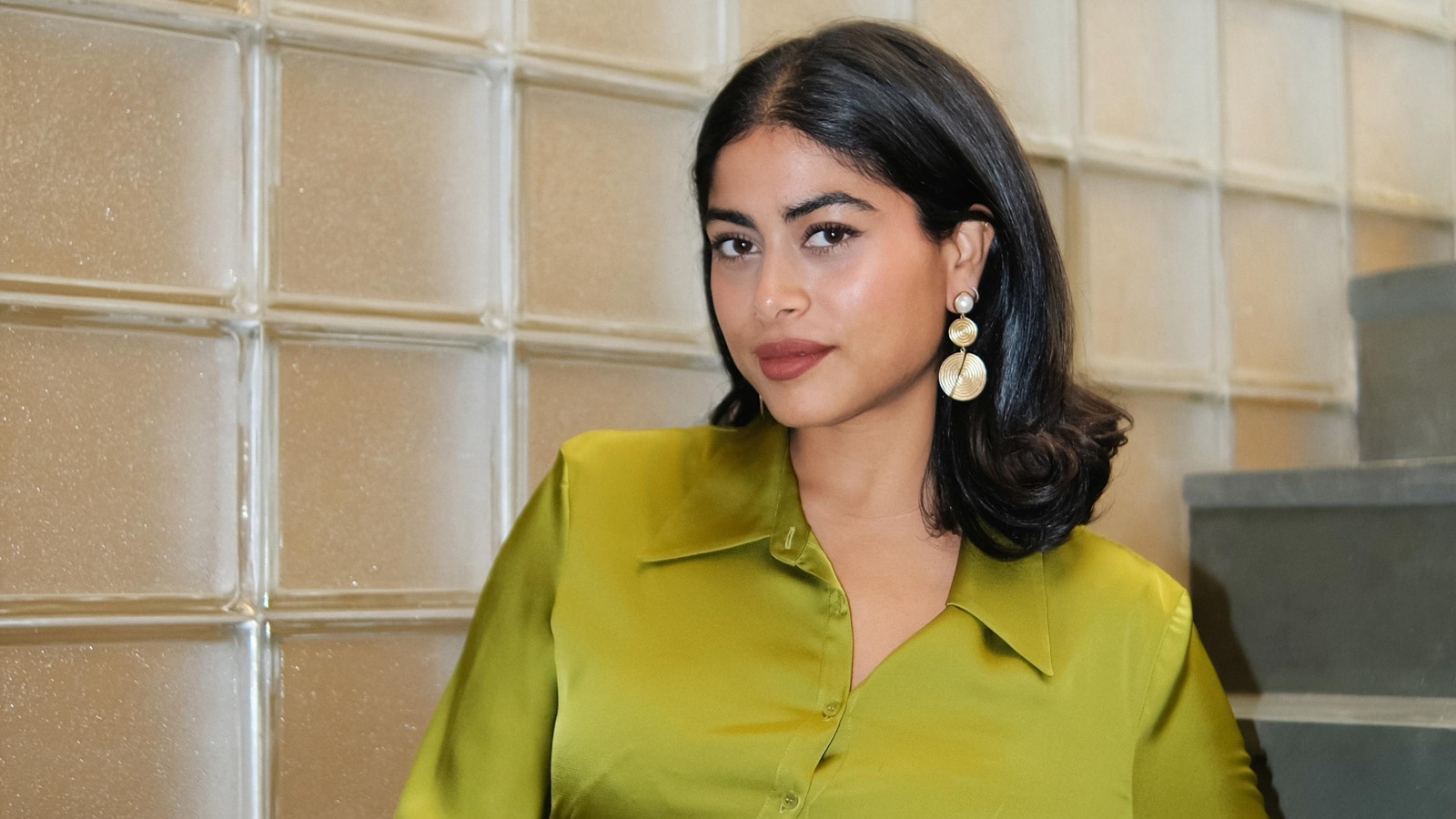
Alaiia Gujral Showcased KŌRA at India Design ID 2026
The work explored weight, balance and surface across marble, metal, glass and dyed fabric
At the Collectible section of India Design ID 2026, held at the NSIC Grounds in Okhla from February 19-22, designer and art curator Alaiia Gujral presented ‘KŌRA’, a process-led installation that brought together furniture, light, textile and spatial elements at Booth C03. The work marked what she described as “the first chapter” of a longer material-led exploration.
Gujral, who works between New Delhi and Chicago, approached ‘KŌRA’ without a fixed concept. “I don’t begin with an idea and then look for materials to support it. I begin with the materials. The work comes from handling them, testing them, and allowing form to emerge through use,” said Gujral.
The installation functioned less as a display of individual products and more as a composed environment. The furniture pieces, including a sofa, centre table and a side table, were not just standalone objects. Added with the standing lamp and the hanging light, the rug, and the wall painting – all with a hint of blue – they brought to life the ambience of a living room.
The floor lamp rose vertically like a column, blue in colour, while a hanging light used translucent recycled material to diffuse rather than spotlight. “The floor lamp grew from experiments with balance and verticality,” she said. “I was interested in how a light source could feel almost architectural.” The hanging piece, she added, became “less about illumination and more about creating a condition in the room.”
The furniture series, ‘KŌRA Terrain’, explored mass and structural tension through marble, metal and glass. The centre tale (low table), for instance, appeared anchored by stone but subtly lifted or interrupted by slender metal elements. “Stone anchors the pieces visually and physically,” Gujral explained. “Metal often acts as a mediator, either supporting the weight or distributing it so the structure feels controlled.” Glass introduced what she described as “a sense of suspension,” allowing heaviness and fragility to coexist.
Textiles played a central role in grounding the space. In ‘KŌRA Weave’, an indigo-dyed textile floor acted as a saturated field from which objects seemed to emerge. The dyeing process connected to Gujral’s earlier work. “My journey into design began with surfaces and material behaviour. I was always drawn to how materials hold memory,” she said. Indigo, which she began working with in 2016, became a way to think through repetition and labour, with hand-dyed works in KŌRA Pulse recording time as surface trace rather than image.
For Gujral, “process-led” meant allowing prototypes and material tests to redirect outcomes. “Small shifts in proportion, balance, or joinery often redirected the design,” she said. “These objects are meant to be used. But use doesn’t erase them,” she added.
Reflecting on the completed installation, she emphasised restraint. “Objects don’t need to shout to hold presence. Sometimes restraint, time, and attention to material are enough,” she said.
At the Collectible section of India Design ID 2026, held at the NSIC Grounds in Okhla from February 19-22, designer and art curator Alaiia Gujral presented ‘KŌRA’, a process-led installation that brought together furniture, light, textile and spatial elements at Booth C03. The work marked what she described as “the first chapter” of a longer material-led exploration.
Gujral, who works between New Delhi and Chicago, approached ‘KŌRA’ without a fixed concept. “I don’t begin with an idea and then look for materials to support it. I begin with the materials. The work comes from handling them, testing them, and allowing form to emerge through use,” said Gujral.
The installation functioned less as a display of individual products and more as a composed environment. The furniture pieces, including a sofa, centre table and a side table, were not just standalone objects. Added with the standing lamp and the hanging light, the rug, and the wall painting – all with a hint of blue – they brought to life the ambience of a living room.
The floor lamp rose vertically like a column, blue in colour, while a hanging light used translucent recycled material to diffuse rather than spotlight. “The floor lamp grew from experiments with balance and verticality,” she said. “I was interested in how a light source could feel almost architectural.” The hanging piece, she added, became “less about illumination and more about creating a condition in the room.”
The furniture series, ‘KŌRA Terrain’, explored mass and structural tension through marble, metal and glass. The centre tale (low table), for instance, appeared anchored by stone but subtly lifted or interrupted by slender metal elements. “Stone anchors the pieces visually and physically,” Gujral explained. “Metal often acts as a mediator, either supporting the weight or distributing it so the structure feels controlled.” Glass introduced what she described as “a sense of suspension,” allowing heaviness and fragility to coexist.
Textiles played a central role in grounding the space. In ‘KŌRA Weave’, an indigo-dyed textile floor acted as a saturated field from which objects seemed to emerge. The dyeing process connected to Gujral’s earlier work. “My journey into design began with surfaces and material behaviour. I was always drawn to how materials hold memory,” she said. Indigo, which she began working with in 2016, became a way to think through repetition and labour, with hand-dyed works in KŌRA Pulse recording time as surface trace rather than image.
For Gujral, “process-led” meant allowing prototypes and material tests to redirect outcomes. “Small shifts in proportion, balance, or joinery often redirected the design,” she said. “These objects are meant to be used. But use doesn’t erase them,” she added.
Reflecting on the completed installation, she emphasised restraint. “Objects don’t need to shout to hold presence. Sometimes restraint, time, and attention to material are enough,” she said.