

No wage hike for MG-NREGS workers for now as Centre looks to roll out VB-G RAM G
It is learnt that the Union Ministry of Rural Development has informed the states that the NREGS wages for fiscal year 2026-27 will be notified when G-RAM G comes into effect.
Over seven crore workers covered under the MG-NREGS may have to wait for a wage hike until the Centre notifies the implementation of Viksit Bharat-Guarantee for Rozgar and Ajeevika Mission (Gramin) (VB-G RAM G) Act, 2025, aimed at replacing the UPA-era job scheme, The Indian Express has learnt.
It is the first time in more than a decade that the Centre has not released a revised NREGS wage notification in February-March.
It is learnt that the Union Ministry of Rural Development (MoRD), the nodal ministry to oversee the implementation of the NREGS, and roll out of the new VB-G RAM G scheme, has informed the states that the NREGS wages for the fiscal year 2026-27 will be notified when the G RAM G comes into effect. Till then, the NREGS wages notified for the fiscal year 2025-26 will continue, it is learnt.
This was informed by the MoRD officials to the state government officials concerned during a video conference recently, said a source.
“They will notify [NREGS wages] when G RAM G comes into force – till then, previous financial year’s rates will continue,” the source said.
The Centre notifies the NREGS wage rates under sub-section (1) of section 6 of the Mahatma Gandhi National Rural Employment Guarantee Act (MGNREGA), 2005.
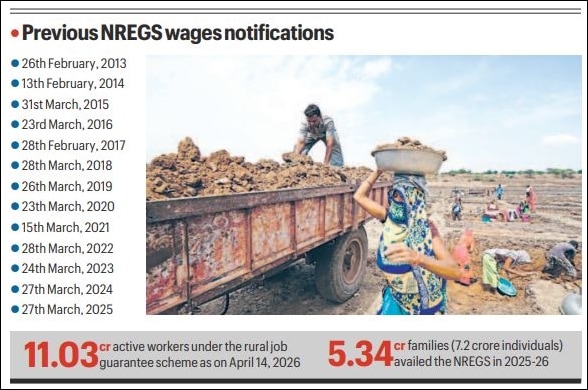
The new rates become effective from the first day (April 1) of the financial year. Usually, the Centre notifies the NREGS wages before the beginning of the new fiscal year but this year, it has not done so even after a fortnight. In the last 13 years, the Centre had notified the NREGS wages for the next financial year in February or March.
A Rural Development Ministry source said, “Conventionally, the wage rates are revised every year, just before the start of the new financial year. Currently, considering the prospective transition from MGNREGA to VB-G RAM G, the existing wage rates will continue during the brief period till the commencement of VB-G RAM G… All workers engaged under the MGNREGS are being paid at the currently notified wage rates, without any interruption or dilution of their legal entitlements…”
The source said, “Workers’ rights remain fully protected during the transition. Employment continues to be provided, and wages are being paid in accordance with existing notifications. Once the new framework is operationalised, revised wage rates will be duly notified and implemented.”
The NREGS wage rates are fixed according to changes in the CPI-AL (Consumer Price Index-Agriculture Labour), which reflects the increase in inflation in the rural areas.
As per the information available on the NREGS dashboard, there were 11.03 crore active workers under the rural job guarantee scheme as on April 14, 2026. In the financial year 2025-26, 5.34 crore families (7.2 crore individuals) availed the NREGS.
Last year, the Centre notified the NREGS wages on March 27, which were applicable for the fiscal year 2025-26 (April-March). The hike was in the range of 2-7% as compared to the previous year.
In December 2025, the NDA government enacted the VB-G RAM G Act, 2025, to repeal the two-decade-old MG-NREGA, 2005, and introduce a new centrally sponsored scheme to provide unskilled wage employment in rural areas.
The Opposition has criticised the government over several provisions of the VB-G RAM G Act. Among such provisions are fund-sharing pattern (Section 22), normative allocation (Sub-section 5 of Section 4), and a pause in employment guarantee during peak agriculture season (Section 6). These provisions will also have a fiscal implication for states, which are already facing challenges.
Departing from the MGNREGA, the VB-G RAM G Act proposes a higher share of states in the funding of the rural job programme. As per the Section 22(1) of the VB-G Ram-G Act, the fund-sharing pattern between the central government and the state governments shall be 90:10 for the 11 states and 60:40 for all other states. Under the MGNREGA, the Centre paid the entire wage bill and shared 75% of material and administrative cost of the scheme.
The government is yet to announce the date on which the new scheme will be implemented. Until then, MG-NREGS will continue, for which the government has allocated Rs 30,000 crore in the Union Budget 2026-27.
Meanwhile, sources say that the MoRD has decided to approve a month-wise NREGS labour budget (the number of persondays to be created) till the new scheme – VB-G RAM G – comes into effect.
For April, the labour budget of 29.94 crore persondays has been approved, which is 11% higher as compared to 26.93 crore persondays in the corresponding month of the last year.
Stay updated with the latest - Click here to follow us on Instagram
Over seven crore workers covered under the MG-NREGS may have to wait for a wage hike until the Centre notifies the implementation of Viksit Bharat-Guarantee for Rozgar and Ajeevika Mission (Gramin) (VB-G RAM G) Act, 2025, aimed at replacing the UPA-era job scheme, The Indian Express has learnt.
It is the first time in more than a decade that the Centre has not released a revised NREGS wage notification in February-March.
It is learnt that the Union Ministry of Rural Development (MoRD), the nodal ministry to oversee the implementation of the NREGS, and roll out of the new VB-G RAM G scheme, has informed the states that the NREGS wages for the fiscal year 2026-27 will be notified when the G RAM G comes into effect. Till then, the NREGS wages notified for the fiscal year 2025-26 will continue, it is learnt.
This was informed by the MoRD officials to the state government officials concerned during a video conference recently, said a source.
“They will notify [NREGS wages] when G RAM G comes into force – till then, previous financial year’s rates will continue,” the source said.
The Centre notifies the NREGS wage rates under sub-section (1) of section 6 of the Mahatma Gandhi National Rural Employment Guarantee Act (MGNREGA), 2005.
The new rates become effective from the first day (April 1) of the financial year. Usually, the Centre notifies the NREGS wages before the beginning of the new fiscal year but this year, it has not done so even after a fortnight. In the last 13 years, the Centre had notified the NREGS wages for the next financial year in February or March.
A Rural Development Ministry source said, “Conventionally, the wage rates are revised every year, just before the start of the new financial year. Currently, considering the prospective transition from MGNREGA to VB-G RAM G, the existing wage rates will continue during the brief period till the commencement of VB-G RAM G… All workers engaged under the MGNREGS are being paid at the currently notified wage rates, without any interruption or dilution of their legal entitlements…”
The source said, “Workers’ rights remain fully protected during the transition. Employment continues to be provided, and wages are being paid in accordance with existing notifications. Once the new framework is operationalised, revised wage rates will be duly notified and implemented.”
The NREGS wage rates are fixed according to changes in the CPI-AL (Consumer Price Index-Agriculture Labour), which reflects the increase in inflation in the rural areas.
As per the information available on the NREGS dashboard, there were 11.03 crore active workers under the rural job guarantee scheme as on April 14, 2026. In the financial year 2025-26, 5.34 crore families (7.2 crore individuals) availed the NREGS.
Last year, the Centre notified the NREGS wages on March 27, which were applicable for the fiscal year 2025-26 (April-March). The hike was in the range of 2-7% as compared to the previous year.
In December 2025, the NDA government enacted the VB-G RAM G Act, 2025, to repeal the two-decade-old MG-NREGA, 2005, and introduce a new centrally sponsored scheme to provide unskilled wage employment in rural areas.
The Opposition has criticised the government over several provisions of the VB-G RAM G Act. Among such provisions are fund-sharing pattern (Section 22), normative allocation (Sub-section 5 of Section 4), and a pause in employment guarantee during peak agriculture season (Section 6). These provisions will also have a fiscal implication for states, which are already facing challenges.
Departing from the MGNREGA, the VB-G RAM G Act proposes a higher share of states in the funding of the rural job programme. As per the Section 22(1) of the VB-G Ram-G Act, the fund-sharing pattern between the central government and the state governments shall be 90:10 for the 11 states and 60:40 for all other states. Under the MGNREGA, the Centre paid the entire wage bill and shared 75% of material and administrative cost of the scheme.
The government is yet to announce the date on which the new scheme will be implemented. Until then, MG-NREGS will continue, for which the government has allocated Rs 30,000 crore in the Union Budget 2026-27.
Meanwhile, sources say that the MoRD has decided to approve a month-wise NREGS labour budget (the number of persondays to be created) till the new scheme – VB-G RAM G – comes into effect.
For April, the labour budget of 29.94 crore persondays has been approved, which is 11% higher as compared to 26.93 crore persondays in the corresponding month of the last year.