

The hammer men of Rajasthan: How new bus safety rules halted an entire industry
Workshops that make 10% of India's sleeper buses say tighter post-accident regulations have brought work to a standstill -- and small manufacturers are paying the price
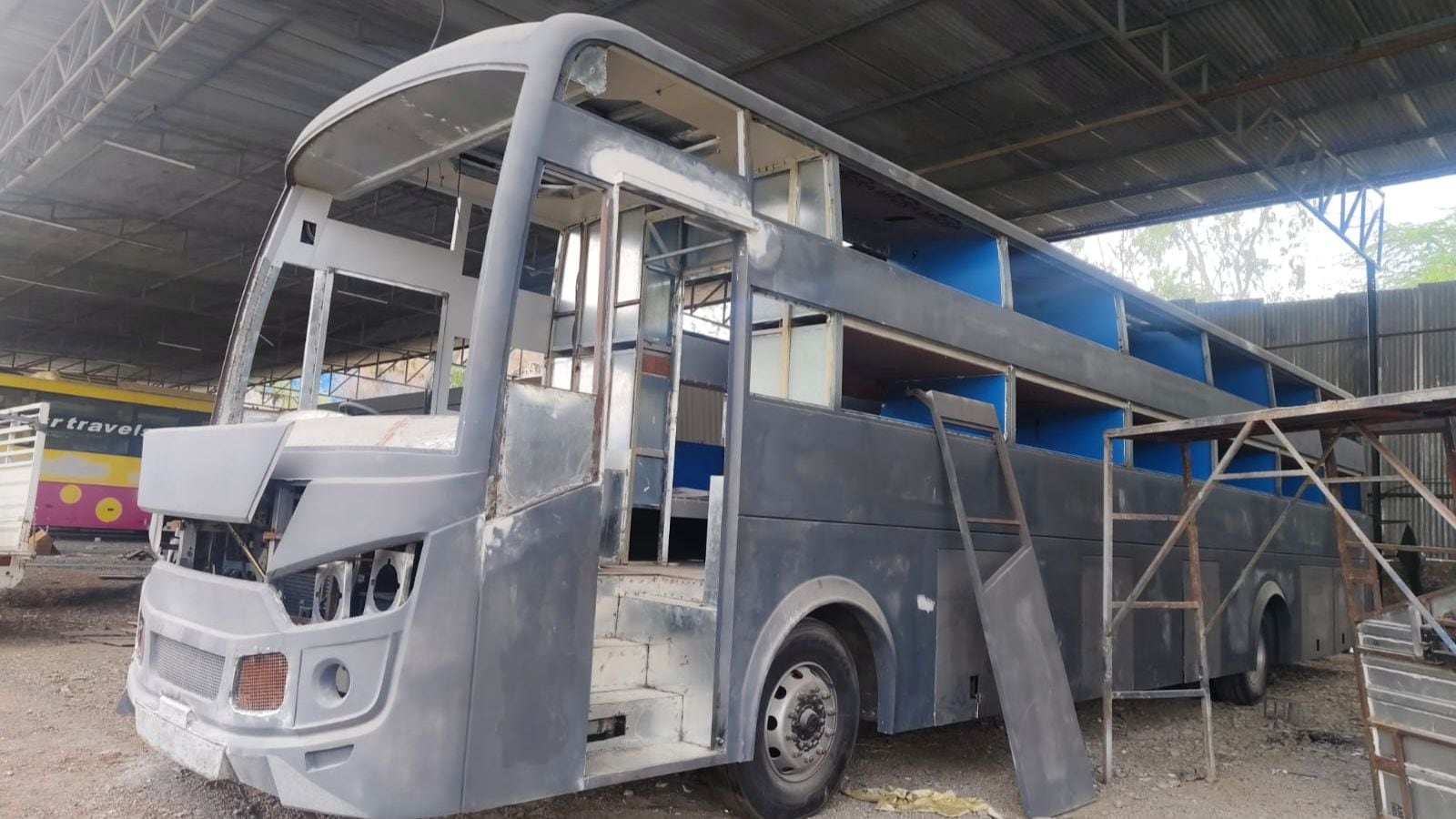
It’s nearly noon, and Sundarlal Suthar sits in the office he shares with his son Bhavesh inside Sundar Coach in Nathdwara in Rajasthan’s Udaipur district, speaking quietly into his mobile phone. It’s the middle of the workday, yet around the workshop, everything is still — unfinished buses and trucks stand in skeletal frames, cans of red and blue paint lie abandoned nearby, and workers amble about with little to do.
“Hathoda maar kehete hain humen [They call us hammer men]. Fifty people are employed here, and 20 buses are manufactured annually,” Sundarlal Suthar, 58-year-old president of Rajasthan Bus and Truck Body Builders Association, says between phone calls. “But since the new manufacturing rules released by the Ministry of Road Transport and Highways (MoRTH) in 2025, and after the Jaisalmer & Andhra Pradesh incident, our work has halted.”
What Sundarlal is referring to is the revised bus body code, AIS-052, made effective from September 1, 2025. First introduced in 2015 to regulate design and safety standards, the latest iteration tightens compliance following a series of deadly bus fires in Jaisalmer and Andhra Pradesh that claimed over 50 lives — but has also brought work at small manufacturing units like his to a halt.
In states like Rajasthan — a major hub producing 10 percent of the country’s sleeper bus bodies and employing thousands — the issue affects thousands of people, from manufacturers to workers. For them, the new rules translate into additional expenses and bureaucratic delays, especially in renewing licences.
The issue is particularly acute for smaller manufacturers — many of these workshops are run by members of the Suthar community, traditionally associated with woodworking, who adapted their skills when bus bodies were once made of wood. “We’ll have to reapply for licences under the new rules,” Sundarlal says. “That will involve time and cost.”
The issue has also gained political traction. Last month month, Congress leaders Rahul Gandhi and Priyanka Gandhi Vadra met a delegation of Rajasthan’s small truck and bus body manufacturers to address their concerns over the new rules. Soon after, Gadkari, who met the delegation, promised that, among other things, the government would offer provisions such as a Rs 5 crore loan to bus body builders and reduce the time required to secure licences.
Gadkari also promised to either reduce or waive licence fees. While the announcement brought some relief on the ground, lack of implementation means work has yet to resume.
Attempts to reach Prem Chand Bairwa, the state’s deputy chief minister who holds the transport portfolio, were unsuccessful.
Under the new compliance rules, the government has mandated that bus body manufacturers strictly follow AIS:052 (Automotive Industry Standard 052) as well as AIS-153 (advanced safety requirements) on fire prevention, passenger evacuation, and structural integrity.
On the ground, this means manufacturers must follow standard design rules, pass government-approved testing, and secure certification — meaning they can no longer modify layouts as before.
In January, Gadkari announced additional safety rules for sleeper buses. These measures — introduced after a series of accidents, including a major bus fire in Jaisalmer last October that killed over 20 people — include mandatory fire detection systems, emergency exits, and driver drowsiness alerts.
Significantly, these rules also state that only established manufacturers can make sleeper coaches.
“Accreditation of bus facilities is to be done by the central government; we have taken it into our hands, so there are no compromises. Existing buses to be retrofitted with a fire detection system, emergency exits with hammers, and emergency lighting. If the driver is sleepy, then we have also provided in our bus, there will be an alarm immediately, drowsiness indicators, which will alert him immediately,” he said.
For manufacturers in Rajasthan — particularly Udaipur — these rules come as a major setback. Of the 700 workshops in Rajasthan, 90 are in Udaipur. Each workshop employs at least 15 people — many of them on contract — and makes an average of Rs 16 crore a year.
For these workshops, most of which are small businesses, the new rules mean a longer process to secure manufacturing licences and, until then, a complete halt in rolling out new buses. While earlier mandates required testing of seat size and spacing, window size and placement, interior layout, and basic safety requirements, the new rules add further requirements — such as sound and vibration testing, sending prototypes of seats and windshields, and testing the chassis.
According to manufacturers, the process could take several months. Additionally, the licence would remain valid only until a new chassis model is introduced or the existing one is modified.
For small manufacturers, this means additional investment of both money and time. Manufacturers say compliance could push costs upwards of Rs 1 crore — a significant increase from the Rs 30 lakh currently.
“Until now, we built on the chassis provided by the client. Now, we will have to purchase a chassis ourselves to ensure compliance. That costs Rs 45 lakh, on top of the bus manufacturing cost of Rs 25 lakh,” Sundarlal’s 25-year-old son Bhavesh says.
This also means a longer approval process. “Once the body is ready, it has to be taken to offices in Pune or Indore for inspection. Only then will we receive a manufacturing licence, costing around Rs 70 lakh. Earlier, we paid about Rs 60,000 as licence fees. Now, even components like windows and gates need to be sent for quality approval,” Bhavesh says.
The rule requiring only established manufacturers to make sleeper coaches is another stress point, with small manufacturers claiming they are being “unfairly penalised” for accidents, most of which were blamed on ruptured fuel tanks and electrical faults in bus air-conditioning systems.
“Our job is to make the structure and interiors,” Mohanlal, the 80-year-old owner of another garage, says. “We have nothing to do with engines or installing ACs. Multibillion-dollar companies manufacture chassis and engines, and ACs are installed by appliance companies. If there’s a fault in that system, the government should hold them accountable.”
When pointed out that a jammed door — part of the bus body — had prevented passengers from escaping the Jaisalmer bus fire, Bhavesh admitted to compliance issues by some small manufacturers.
“A lot of small manufacturers do break rules, and the government should act,” he says. “But there are times when clients — bus owners — replace emergency doors with an extra seat, and we’re pressured to comply. These must be dealt with too.”
Since Gadkari’s announcement, there has been no movement, with manufacturers alleging that even buses operating before the new rules came into effect are being stopped on the road by the Rajasthan Transport Authority.
Rajesh Garhwal, a transporter from Jaipur, says three of his buses were stopped despite approval from the Regional Transport Office. “Now I’m running around for approval,” he says.
As work remains stalled, manufacturers are considering how to implement the new safety rules. As he watches some workers doing repairs in another workshop in Udaipur, owner Himanshu Suthar, 25, lists the changes: two exits, hammers under each seat to break windows, and panic buttons.
But he has reservations. “I’m concerned about theft. Passengers have stolen hammers from under the seats,” he says.
With all new work halted, workshops are limited to repairing older buses and trucks. But this too is insufficient, and the lack of revenue is affecting workers. “I used to make Rs 25,000 to 30,000 a month, but since work stopped, I haven’t earned anything,” Chunni Lal, a 71-year-old worker at Himanshu’s workshop, says.
Stay updated with the latest - Click here to follow us on Instagram
It’s nearly noon, and Sundarlal Suthar sits in the office he shares with his son Bhavesh inside Sundar Coach in Nathdwara in Rajasthan’s Udaipur district, speaking quietly into his mobile phone. It’s the middle of the workday, yet around the workshop, everything is still — unfinished buses and trucks stand in skeletal frames, cans of red and blue paint lie abandoned nearby, and workers amble about with little to do.
“Hathoda maar kehete hain humen [They call us hammer men]. Fifty people are employed here, and 20 buses are manufactured annually,” Sundarlal Suthar, 58-year-old president of Rajasthan Bus and Truck Body Builders Association, says between phone calls. “But since the new manufacturing rules released by the Ministry of Road Transport and Highways (MoRTH) in 2025, and after the Jaisalmer & Andhra Pradesh incident, our work has halted.”
What Sundarlal is referring to is the revised bus body code, AIS-052, made effective from September 1, 2025. First introduced in 2015 to regulate design and safety standards, the latest iteration tightens compliance following a series of deadly bus fires in Jaisalmer and Andhra Pradesh that claimed over 50 lives — but has also brought work at small manufacturing units like his to a halt.
In states like Rajasthan — a major hub producing 10 percent of the country’s sleeper bus bodies and employing thousands — the issue affects thousands of people, from manufacturers to workers. For them, the new rules translate into additional expenses and bureaucratic delays, especially in renewing licences.
The issue is particularly acute for smaller manufacturers — many of these workshops are run by members of the Suthar community, traditionally associated with woodworking, who adapted their skills when bus bodies were once made of wood. “We’ll have to reapply for licences under the new rules,” Sundarlal says. “That will involve time and cost.”
The issue has also gained political traction. Last month month, Congress leaders Rahul Gandhi and Priyanka Gandhi Vadra met a delegation of Rajasthan’s small truck and bus body manufacturers to address their concerns over the new rules. Soon after, Gadkari, who met the delegation, promised that, among other things, the government would offer provisions such as a Rs 5 crore loan to bus body builders and reduce the time required to secure licences.
Gadkari also promised to either reduce or waive licence fees. While the announcement brought some relief on the ground, lack of implementation means work has yet to resume.
Attempts to reach Prem Chand Bairwa, the state’s deputy chief minister who holds the transport portfolio, were unsuccessful.
Under the new compliance rules, the government has mandated that bus body manufacturers strictly follow AIS:052 (Automotive Industry Standard 052) as well as AIS-153 (advanced safety requirements) on fire prevention, passenger evacuation, and structural integrity.
On the ground, this means manufacturers must follow standard design rules, pass government-approved testing, and secure certification — meaning they can no longer modify layouts as before.
In January, Gadkari announced additional safety rules for sleeper buses. These measures — introduced after a series of accidents, including a major bus fire in Jaisalmer last October that killed over 20 people — include mandatory fire detection systems, emergency exits, and driver drowsiness alerts.
Significantly, these rules also state that only established manufacturers can make sleeper coaches.
“Accreditation of bus facilities is to be done by the central government; we have taken it into our hands, so there are no compromises. Existing buses to be retrofitted with a fire detection system, emergency exits with hammers, and emergency lighting. If the driver is sleepy, then we have also provided in our bus, there will be an alarm immediately, drowsiness indicators, which will alert him immediately,” he said.
For manufacturers in Rajasthan — particularly Udaipur — these rules come as a major setback. Of the 700 workshops in Rajasthan, 90 are in Udaipur. Each workshop employs at least 15 people — many of them on contract — and makes an average of Rs 16 crore a year.
For these workshops, most of which are small businesses, the new rules mean a longer process to secure manufacturing licences and, until then, a complete halt in rolling out new buses. While earlier mandates required testing of seat size and spacing, window size and placement, interior layout, and basic safety requirements, the new rules add further requirements — such as sound and vibration testing, sending prototypes of seats and windshields, and testing the chassis.
According to manufacturers, the process could take several months. Additionally, the licence would remain valid only until a new chassis model is introduced or the existing one is modified.
For small manufacturers, this means additional investment of both money and time. Manufacturers say compliance could push costs upwards of Rs 1 crore — a significant increase from the Rs 30 lakh currently.
“Until now, we built on the chassis provided by the client. Now, we will have to purchase a chassis ourselves to ensure compliance. That costs Rs 45 lakh, on top of the bus manufacturing cost of Rs 25 lakh,” Sundarlal’s 25-year-old son Bhavesh says.
This also means a longer approval process. “Once the body is ready, it has to be taken to offices in Pune or Indore for inspection. Only then will we receive a manufacturing licence, costing around Rs 70 lakh. Earlier, we paid about Rs 60,000 as licence fees. Now, even components like windows and gates need to be sent for quality approval,” Bhavesh says.
The rule requiring only established manufacturers to make sleeper coaches is another stress point, with small manufacturers claiming they are being “unfairly penalised” for accidents, most of which were blamed on ruptured fuel tanks and electrical faults in bus air-conditioning systems.
“Our job is to make the structure and interiors,” Mohanlal, the 80-year-old owner of another garage, says. “We have nothing to do with engines or installing ACs. Multibillion-dollar companies manufacture chassis and engines, and ACs are installed by appliance companies. If there’s a fault in that system, the government should hold them accountable.”
When pointed out that a jammed door — part of the bus body — had prevented passengers from escaping the Jaisalmer bus fire, Bhavesh admitted to compliance issues by some small manufacturers.
“A lot of small manufacturers do break rules, and the government should act,” he says. “But there are times when clients — bus owners — replace emergency doors with an extra seat, and we’re pressured to comply. These must be dealt with too.”
Since Gadkari’s announcement, there has been no movement, with manufacturers alleging that even buses operating before the new rules came into effect are being stopped on the road by the Rajasthan Transport Authority.
Rajesh Garhwal, a transporter from Jaipur, says three of his buses were stopped despite approval from the Regional Transport Office. “Now I’m running around for approval,” he says.
As work remains stalled, manufacturers are considering how to implement the new safety rules. As he watches some workers doing repairs in another workshop in Udaipur, owner Himanshu Suthar, 25, lists the changes: two exits, hammers under each seat to break windows, and panic buttons.
But he has reservations. “I’m concerned about theft. Passengers have stolen hammers from under the seats,” he says.
With all new work halted, workshops are limited to repairing older buses and trucks. But this too is insufficient, and the lack of revenue is affecting workers. “I used to make Rs 25,000 to 30,000 a month, but since work stopped, I haven’t earned anything,” Chunni Lal, a 71-year-old worker at Himanshu’s workshop, says.