

PM Modi calls for openness, slams countries and firms developing AI ‘confidentially’
The PM presented India’s ‘MANAV’ (human) vision for AI, which covers principles including building moral and ethical systems that are accessible and inclusive, accountable governance, national sovereignty, and lawful use of the technology.
During his speech at the India-AI Impact Summit Thursday, Prime Minister Narendra Modi slammed countries and companies that consider AI a strategic asset and develop the technology “confidentially”. He called for the development of open-source systems.
The PM’s comments come a day after senior White House Policy Advisor on artificial intelligence (AI) Sriram Krishnan Wednesday said the US expects its allies, including India, to build their AI solutions on top of America’s AI stack.
PM Modi said while some countries and companies consider AI a strategic asset to be developed confidentially, India believes AI will benefit the world only when it is shared. He emphasised that open code and shared development will allow millions of young minds to make AI better and safer. He called for a collective resolve to develop AI as a “global common good”.
On Thursday, The Indian Express reported that as part of its key deliverables post the India-AI Impact Summit, Delhi is likely to push for more “democratised” use of AI. A key focus is likely on affordability and access to the technology, a move which government officials say will counter the general direction of AI development in the West, where AI development is concentrated in the hands of a few companies and individuals.
The AI Impact Summit in Delhi has brought together the who’s who from the AI world.
There is representation from over 100 countries.
There are distinguished participants from every corner of the globe.
Our aim is the same – leveraging the power of AI for the welfare of our… pic.twitter.com/BHkvMOJsVN
— Narendra Modi (@narendramodi) February 19, 2026
Highlighting the urgent need for global standards, the Prime Minister pointed out that deepfakes and fabricated content are “destabilising” open societies. Drawing a parallel with nutrition labels on food, he said that digital content too must carry authenticity labels so people can distinguish between real and AI-generated material. He underlined the growing need for watermarking and clear source standards as AI increasingly generates text, images, and videos, stressing that safety must be built into technology from the start.
The PM presented India’s ‘MANAV’ (human) vision for AI, which covers principles including building moral and ethical systems that are accessible and inclusive, accountable governance, national sovereignty, and lawful use of the technology.
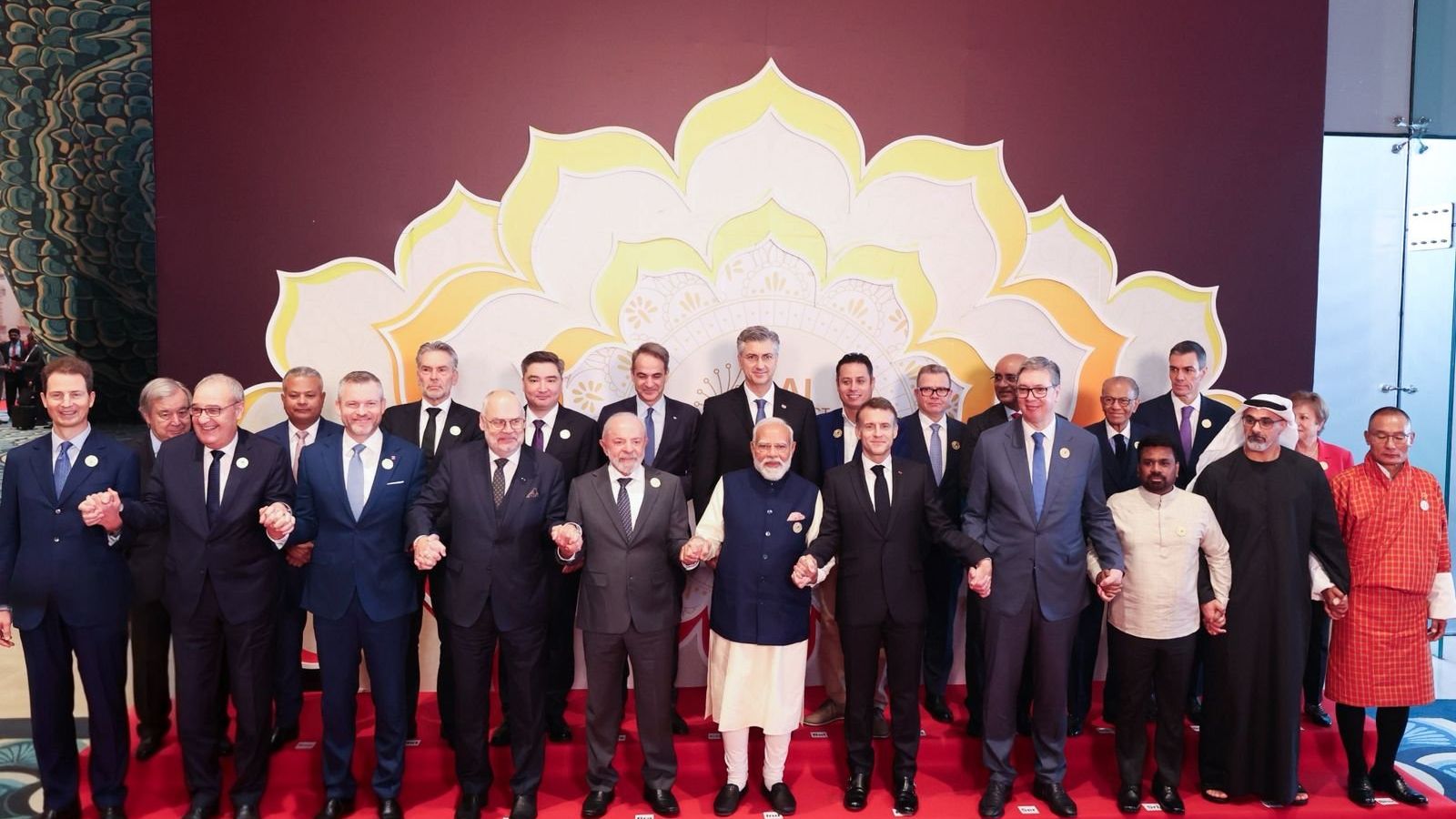
World and corporate leaders including French President Emmanuel Macron, Brazilian President Luiz Inacio Lula da Silva, Google’s Sunar Pichai, OpenAI’s Sam Altman, and Anthropic’s Dario Amodei, among others were in attendance.
Modi said that AI will also open higher-value, creative, and meaningful roles for more people, creating opportunities for innovation, entrepreneurship, and new industries. He stressed the importance of skilling, reskilling, and upskilling as crucial pillars.
He also said that India is building a resilient ecosystem ranging from semiconductors to quantum computing. He highlighted that secure data centers, a strong IT backbone, and a dynamic startup ecosystem make India a natural hub for affordable, scalable, and secure AI solutions. “Any AI model that succeeds in India can be deployed globally,” the PM said.
Highlighting the importance of child safety, the Prime Minister stated that just as school syllabi are curated, the AI space must also be child-safe and family-guided. He remarked that today there are two kinds of people — those who see fear in AI and those who see fortune, adding that India sees fortune and future in AI, backed by talent, energy capacity, and policy clarity.
During his speech at the India-AI Impact Summit Thursday, Prime Minister Narendra Modi slammed countries and companies that consider AI a strategic asset and develop the technology “confidentially”. He called for the development of open-source systems.
The PM’s comments come a day after senior White House Policy Advisor on artificial intelligence (AI) Sriram Krishnan Wednesday said the US expects its allies, including India, to build their AI solutions on top of America’s AI stack.
PM Modi said while some countries and companies consider AI a strategic asset to be developed confidentially, India believes AI will benefit the world only when it is shared. He emphasised that open code and shared development will allow millions of young minds to make AI better and safer. He called for a collective resolve to develop AI as a “global common good”.
On Thursday, The Indian Express reported that as part of its key deliverables post the India-AI Impact Summit, Delhi is likely to push for more “democratised” use of AI. A key focus is likely on affordability and access to the technology, a move which government officials say will counter the general direction of AI development in the West, where AI development is concentrated in the hands of a few companies and individuals.
The AI Impact Summit in Delhi has brought together the who’s who from the AI world.
There is representation from over 100 countries.
There are distinguished participants from every corner of the globe.
Our aim is the same – leveraging the power of AI for the welfare of our… pic.twitter.com/BHkvMOJsVN
— Narendra Modi (@narendramodi) February 19, 2026
Highlighting the urgent need for global standards, the Prime Minister pointed out that deepfakes and fabricated content are “destabilising” open societies. Drawing a parallel with nutrition labels on food, he said that digital content too must carry authenticity labels so people can distinguish between real and AI-generated material. He underlined the growing need for watermarking and clear source standards as AI increasingly generates text, images, and videos, stressing that safety must be built into technology from the start.
The PM presented India’s ‘MANAV’ (human) vision for AI, which covers principles including building moral and ethical systems that are accessible and inclusive, accountable governance, national sovereignty, and lawful use of the technology.
World and corporate leaders including French President Emmanuel Macron, Brazilian President Luiz Inacio Lula da Silva, Google’s Sunar Pichai, OpenAI’s Sam Altman, and Anthropic’s Dario Amodei, among others were in attendance.
Modi said that AI will also open higher-value, creative, and meaningful roles for more people, creating opportunities for innovation, entrepreneurship, and new industries. He stressed the importance of skilling, reskilling, and upskilling as crucial pillars.
He also said that India is building a resilient ecosystem ranging from semiconductors to quantum computing. He highlighted that secure data centers, a strong IT backbone, and a dynamic startup ecosystem make India a natural hub for affordable, scalable, and secure AI solutions. “Any AI model that succeeds in India can be deployed globally,” the PM said.
Highlighting the importance of child safety, the Prime Minister stated that just as school syllabi are curated, the AI space must also be child-safe and family-guided. He remarked that today there are two kinds of people — those who see fear in AI and those who see fortune, adding that India sees fortune and future in AI, backed by talent, energy capacity, and policy clarity.