

India’s high-speed rail dreams taking shape in this nondescript Adivasi village
Of the 508-km project, over 90% of the line will run on viaducts, making a ride through the skies
Nearly 118-km from Mumbai, the innocuous silence of Sakhare village in Palghar is broken by the periodic thumping of massive machinery. The long, white coloured viaduct running over it stands in sharp contrast. The houses of Adivasis may be old and kutcha, yet the village is now the launchpad for one of India’s biggest infrastructure projects — the Mumbai-Ahmedabad High Speed Rail corridor, the country’s first bullet train project.
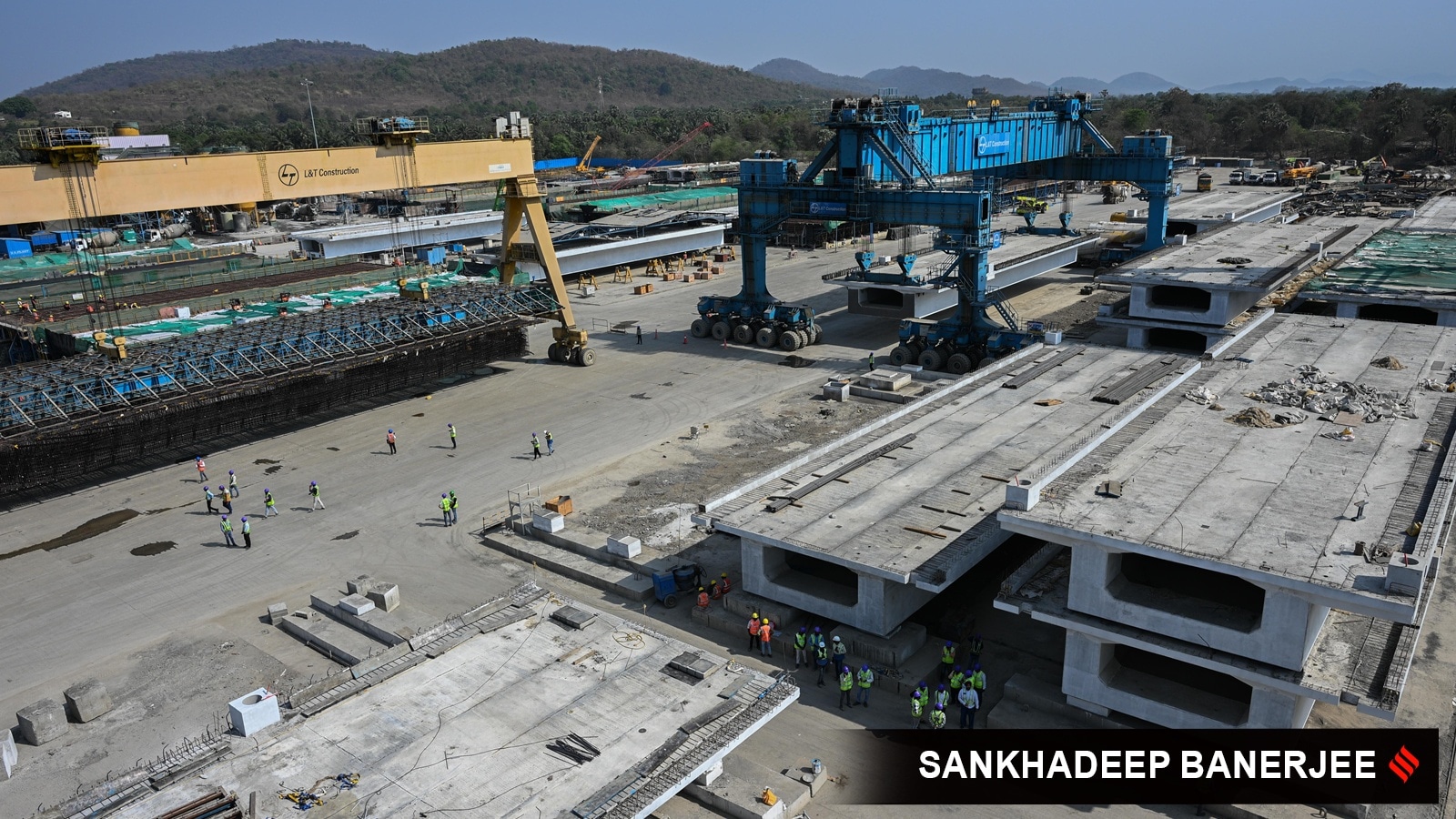
Spread across 50 acres in this village, it is one of the nine casting yards in Maharashtra set up along the high-speed rail corridor to manufacture the girders that will form the project’s viaducts. It is also the site where some of the most technically advanced machines operate round the clock. They are capable of lifting unimaginable weight and are so massive in size that they are visible from every corner of the Sakhare, with the Sahyadri mountains overlooking it.
The blue straddle carrier, visible at a far distance, looks like a machine straight out of the Transformer series. Weighing 380 tonnes and supported by four massive legs mounted on 80 large tyres, it moves slowly across the casting yard while lifting a 1000-tonne and 40 meters large girder of the bullet train project. In the long shot, the suspended girder from its wires appears weightless, like a bird flying with its wings spread.
A girder is the precast segment that is placed between two pillars to form the viaduct at elevated level on which the bullet train will run, like most of the metro projects. Of the 508-km high speed rail project, 465-km (92%) is the viaduct, making almost the entire project at the elevated level. The work in Gujarat section (348 km) is almost complete and the work in Mumbai section (156-km) — which was delayed due to land acquisition — has gathered pace.
Ajay Mane, in-charge of the casting yard operated by L&T, said daily at least one girder is launched, meaning that they are lifted and placed on the viaduct pillars.
“This casting yard will manufacture the girder for 22 kilometers of the total project. It will launch a total of 527 girders for this area. We have been able to launch 58 girders so far,” said Mane.
A senior official of the National High Speed Rail Corporation Ltd (NHSRCL) said that for the entire project, around 11,500 girders have to be launched to make the 465-km viaduct out of which, around 8,500 girders have been launched.
“We are launching 7-8 times faster than the Japanese. The light here does not go off anytime, the work goes on round the clock,” said the L&T official, as the work is being expedited for the Mumbai section.
The first section of the project, from Surat to Bilimora in Gujarat, is slated for completion by August 15, 2027. The entire 508-km project is expected to be ready by December 2029. While progress for the Gujarat section was almost 68%, the progress for the Maharashtra section was only 41% till March 2026.
A smaller straddle carrier moves with the 44 tonnes iron cage to begin the girder casting process, which will go on for the next 14 days.
“The casting of a girder for the bullet train is very complex and technical. Even though it weighs almost 1,000 tonnes, it is relatively less heavy for its size. This is where design comes into play. It gives the girder such a shape — a rectangular opening in the middle — that it is not that heavy, to ensure that piers don’t have to bear so much weight that there is a danger of it collapsing. At the same time, the design gives it so much strength — 50 MPa (Megapascal) — that it can easily hold the movement of a bullet train over it. If you look at it from below, a girder on the pier looks like a bird flying with open wings,” said Satish Chaurasia, a Chief project manager of NHSRCL at the site, as the iron cage is placed in the mould to begin the pouring of concrete.
The ready-mix concrete (RMC) truck, with boom placer mounted over, is lined up from the batching plant at a corner of the casting yard. It is not one or two trucks, it will require 65 trucks of concrete mixture — equivalent to 400-cubic meter concrete — for casting just one girder. For comparison, the roof of an ordinary house typically requires just two to three RMC truckloads.
“It will take another 8-10 hours to pour the concrete in the iron cage placed in the mould. After that, we will pour water over it for the curing, like we do in the new houses. This is done so that the girder achieves strength. There is another unique aspect of these girders. While concrete is what is visible, it is the high-tensile wires placed within, stretched almost to their maximum and then locked at both ends, that hold the entire structure together and prevent it from crumbling. In a way, the entire bullet train runs on these wires,” explains Chaurasia.
Nearly 1,000 employees work at the site, carrying out a series of coordinated activities around the clock. Engineers say such meticulous and complex engineering was last witnessed during the construction of the Mumbai Trans Harbour Link and the Narmada Cable-Stayed Bridge.
On one corner of the site, the new girders, after 14-days of strengthening work, are being stacked over one after another by the straddle carrier. The white colour on the girders is not paint, but a chemical compound sprayed on the outer surface to cure it. “Had it not been this chemical compound, we would have had to use thousands of litres of water for the curing and strengthening of one girder. This allows the concrete to retain moisture and prevent cracking by reflecting the sun,” said an NHSRCL engineer at the site.
Next comes the two 40-meters high Bridge Gantry — equivalent to the height of an 11 floor building. Weighing 350 tonnes each, it moves over a track laid in the yard. The wires suspended from both gantries lift the 1,000 tonnes girder from the stacking area and place it over the girder transported standing on the viaduct, almost 25 meters from the ground.
Another massive machine, the girder transporter, with a self-weight of 380 metric tonnes and moved by 216 tyres, runs at a snail’s pace along the viaduct carrying a 1,000 tonne girder to the launching area, extending the viaduct already formed through the placement of previous girders.
“There is an interesting thing about this entire process. For the railway projects at the elevated level, the load testing is very important and this marks the completion of the project. Here, the load testing is done at the same time a girder is launched. On a girder, a 380 tonnes transporter, plus 1,000 tonnes girder weight moves across the structure. This means that the girders and piers can hold the weight of almost 1,400 tonnes. In the next 100 years, it would not have to hold this much weight, no matter whether the bullet train runs with its fullest passenger capacity or more,” said a NHSRCL official.
Two kilometers away, the girder which left the Sakhare casting yard is being launched with the help of a blue coloured gantry, weighing 540 tonnes, capable of holding 1,100 tonnes. After around four hours of meticulous exercise, the gantry rightly places the girder between two piers.
The siren goes out loud after the completion of the work. An Adivasi man looks at the towering structure from his small house — so physically close, yet a world away from experiencing the journey himself. Almost 54-km from here and close to the Arabian sea, the Boisar station for the high speed rail is taking shape, where the viaduct will eventually connect.
Nearly 118-km from Mumbai, the innocuous silence of Sakhare village in Palghar is broken by the periodic thumping of massive machinery. The long, white coloured viaduct running over it stands in sharp contrast. The houses of Adivasis may be old and kutcha, yet the village is now the launchpad for one of India’s biggest infrastructure projects — the Mumbai-Ahmedabad High Speed Rail corridor, the country’s first bullet train project.
Spread across 50 acres in this village, it is one of the nine casting yards in Maharashtra set up along the high-speed rail corridor to manufacture the girders that will form the project’s viaducts. It is also the site where some of the most technically advanced machines operate round the clock. They are capable of lifting unimaginable weight and are so massive in size that they are visible from every corner of the Sakhare, with the Sahyadri mountains overlooking it.
The blue straddle carrier, visible at a far distance, looks like a machine straight out of the Transformer series. Weighing 380 tonnes and supported by four massive legs mounted on 80 large tyres, it moves slowly across the casting yard while lifting a 1000-tonne and 40 meters large girder of the bullet train project. In the long shot, the suspended girder from its wires appears weightless, like a bird flying with its wings spread.
A girder is the precast segment that is placed between two pillars to form the viaduct at elevated level on which the bullet train will run, like most of the metro projects. Of the 508-km high speed rail project, 465-km (92%) is the viaduct, making almost the entire project at the elevated level. The work in Gujarat section (348 km) is almost complete and the work in Mumbai section (156-km) — which was delayed due to land acquisition — has gathered pace.
Ajay Mane, in-charge of the casting yard operated by L&T, said daily at least one girder is launched, meaning that they are lifted and placed on the viaduct pillars.
“This casting yard will manufacture the girder for 22 kilometers of the total project. It will launch a total of 527 girders for this area. We have been able to launch 58 girders so far,” said Mane.
A senior official of the National High Speed Rail Corporation Ltd (NHSRCL) said that for the entire project, around 11,500 girders have to be launched to make the 465-km viaduct out of which, around 8,500 girders have been launched.
“We are launching 7-8 times faster than the Japanese. The light here does not go off anytime, the work goes on round the clock,” said the L&T official, as the work is being expedited for the Mumbai section.
The first section of the project, from Surat to Bilimora in Gujarat, is slated for completion by August 15, 2027. The entire 508-km project is expected to be ready by December 2029. While progress for the Gujarat section was almost 68%, the progress for the Maharashtra section was only 41% till March 2026.
A smaller straddle carrier moves with the 44 tonnes iron cage to begin the girder casting process, which will go on for the next 14 days.
“The casting of a girder for the bullet train is very complex and technical. Even though it weighs almost 1,000 tonnes, it is relatively less heavy for its size. This is where design comes into play. It gives the girder such a shape — a rectangular opening in the middle — that it is not that heavy, to ensure that piers don’t have to bear so much weight that there is a danger of it collapsing. At the same time, the design gives it so much strength — 50 MPa (Megapascal) — that it can easily hold the movement of a bullet train over it. If you look at it from below, a girder on the pier looks like a bird flying with open wings,” said Satish Chaurasia, a Chief project manager of NHSRCL at the site, as the iron cage is placed in the mould to begin the pouring of concrete.
The ready-mix concrete (RMC) truck, with boom placer mounted over, is lined up from the batching plant at a corner of the casting yard. It is not one or two trucks, it will require 65 trucks of concrete mixture — equivalent to 400-cubic meter concrete — for casting just one girder. For comparison, the roof of an ordinary house typically requires just two to three RMC truckloads.
“It will take another 8-10 hours to pour the concrete in the iron cage placed in the mould. After that, we will pour water over it for the curing, like we do in the new houses. This is done so that the girder achieves strength. There is another unique aspect of these girders. While concrete is what is visible, it is the high-tensile wires placed within, stretched almost to their maximum and then locked at both ends, that hold the entire structure together and prevent it from crumbling. In a way, the entire bullet train runs on these wires,” explains Chaurasia.
Nearly 1,000 employees work at the site, carrying out a series of coordinated activities around the clock. Engineers say such meticulous and complex engineering was last witnessed during the construction of the Mumbai Trans Harbour Link and the Narmada Cable-Stayed Bridge.
On one corner of the site, the new girders, after 14-days of strengthening work, are being stacked over one after another by the straddle carrier. The white colour on the girders is not paint, but a chemical compound sprayed on the outer surface to cure it. “Had it not been this chemical compound, we would have had to use thousands of litres of water for the curing and strengthening of one girder. This allows the concrete to retain moisture and prevent cracking by reflecting the sun,” said an NHSRCL engineer at the site.
Next comes the two 40-meters high Bridge Gantry — equivalent to the height of an 11 floor building. Weighing 350 tonnes each, it moves over a track laid in the yard. The wires suspended from both gantries lift the 1,000 tonnes girder from the stacking area and place it over the girder transported standing on the viaduct, almost 25 meters from the ground.
Another massive machine, the girder transporter, with a self-weight of 380 metric tonnes and moved by 216 tyres, runs at a snail’s pace along the viaduct carrying a 1,000 tonne girder to the launching area, extending the viaduct already formed through the placement of previous girders.
“There is an interesting thing about this entire process. For the railway projects at the elevated level, the load testing is very important and this marks the completion of the project. Here, the load testing is done at the same time a girder is launched. On a girder, a 380 tonnes transporter, plus 1,000 tonnes girder weight moves across the structure. This means that the girders and piers can hold the weight of almost 1,400 tonnes. In the next 100 years, it would not have to hold this much weight, no matter whether the bullet train runs with its fullest passenger capacity or more,” said a NHSRCL official.
Two kilometers away, the girder which left the Sakhare casting yard is being launched with the help of a blue coloured gantry, weighing 540 tonnes, capable of holding 1,100 tonnes. After around four hours of meticulous exercise, the gantry rightly places the girder between two piers.
The siren goes out loud after the completion of the work. An Adivasi man looks at the towering structure from his small house — so physically close, yet a world away from experiencing the journey himself. Almost 54-km from here and close to the Arabian sea, the Boisar station for the high speed rail is taking shape, where the viaduct will eventually connect.